Used Car Sale Receipt Template
Enter the used vehicle’s details, buyer and payment amount. Add only the history-check and warranty information you have verified for that sale.
Last updated
Keep vehicle details beside the payment record
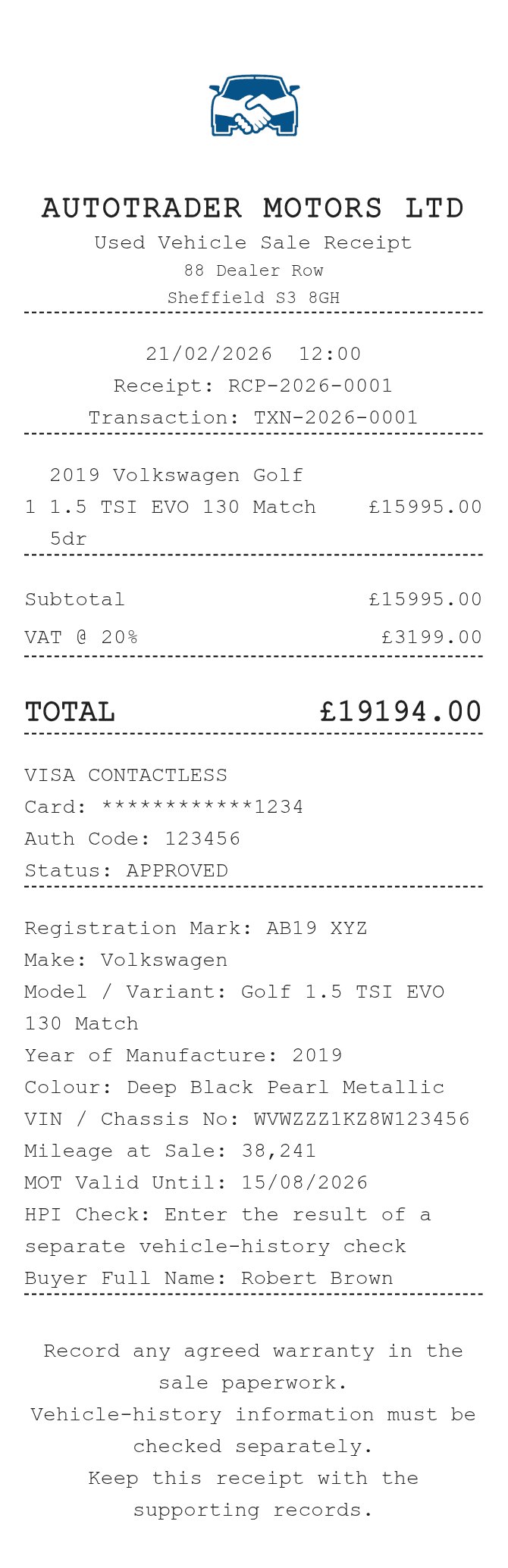
This used-car layout includes separate make, model, year, color, VIN, mileage and MOT-expiration fields, plus a buyer name and a history-check note. The example uses pounds and a dealer-style header, which you can edit. It does not check the vehicle’s history or establish what warranty applies.
What a used car sale receipt should match in the UK
A used car sale receipt is most useful when its details line up with official records. Citizens Advice suggests checking the car's details against DVLA records with the free online vehicle information checker, and reporting the seller to the police if the log book (V5C registration certificate) does not match. GOV.UK's MOT history service shows whether the car passed or failed each test, the mileage recorded at each test and when the next MOT is due. For cars, it covers tests since 2005, so comparing those readings with the mileage written on the receipt is a simple check before you pay.
Citizens Advice says to get the original log book and the valid MOT test document, not photocopies, and never to buy a car without the log book. Vehicle tax does not pass to the buyer. Once the seller tells DVLA, their tax is canceled and they can get a refund for full remaining months, while the buyer must tax the car or declare it off the road (SORN) before driving it. How you pay also matters: a credit card payment can bring section 75 protection for goods costing between £100 and £30,000, even if only part was paid on the card.
Paperwork to keep with the receipt
The seller should tell DVLA about the sale online through GOV.UK, which also cancels their vehicle tax. If there is no log book, the seller writes to DVLA with the exact sale date and the new keeper's details, and the buyer applies for a vehicle registration certificate on form V62. Keep the receipt with the V5C, the MOT document and any written description of the car, because your legal rights depend on what you were told at the time of sale.
Vehicle and sale information
| Section | Details |
|---|---|
| Vehicle identity | Registration, make, model, year, color and VIN |
| Mileage and inspection | Mileage, MOT expiration and HPI/history-check text |
| Parties | Business header and buyer name |
| Payment | Receipt date, references, line amount and payment details |
| Agreed notes | Editable footer for supporting sale or warranty information |
Related receipt guides
Check the example before using it
- Replace every vehicle identifier and the sample business details.
- Enter the full line amount. Quantity does not multiply that amount in this version.
- Review Tax% carefully: the calculator adds that percentage to the subtotal. It does not calculate a VAT margin scheme or choose the tax treatment for the sale.
- Use the history-check field for an actual result or leave it blank; do not treat the sample as a completed check.
FAQs
Sources and references
- HMRC: VAT margin schemes
- GOV.UK - Tell DVLA you've sold, transferred or bought a vehicle
- GOV.UK - Check the MOT history of a vehicle
- Citizens Advice - Buying a used car
- Citizens Advice - Problem with a used car