Private Car Sale Receipt Template
Record the buyer, seller, vehicle and payment for a private car sale. Check the condition notes and amount received before saving your receipt.
Last updated
Write a payment record both parties can check
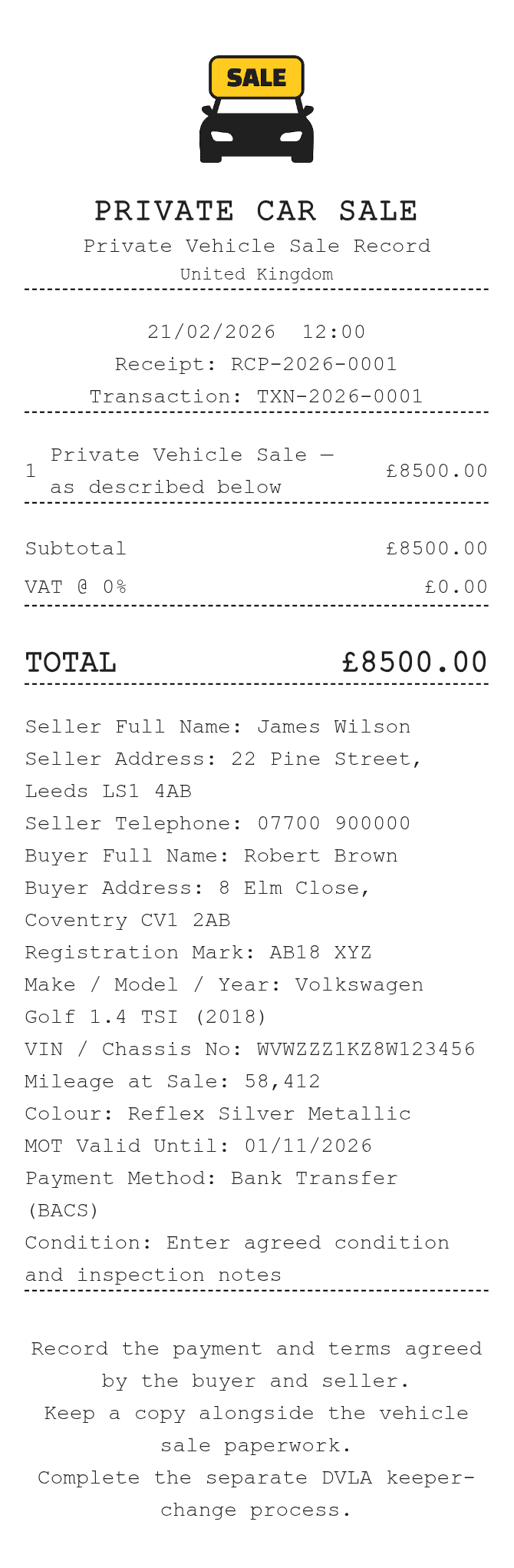
This template starts with a UK private-sale layout. It includes contact details for the seller, the buyer’s name and address, vehicle registration, VIN, mileage and MOT expiration. Fill those fields from the sale records and describe the payment accurately, including whether it was a deposit or the final amount.
What the law expects in a UK private car sale
A private sale is not covered by the Consumer Rights Act 2015, which deals with traders selling to consumers. The Sale of Goods Act 1979 still applies. Under section 13, goods sold by description must match that description. The satisfactory quality term in section 14 applies only when the seller sells in the course of a business. Citizens Advice says a buyer may be entitled to a repair or some or all of the money back if the car does not match the advert or description, but not for a fault that was fully explained, one an inspection should have revealed, or normal wear and tear. That is why the receipt and advert are worth keeping together.
A private car sale receipt also matters if the car turns out to still be under a hire purchase or conditional sale agreement. Citizens Advice says you usually keep the car, which the law calls good title, if you did not know about the agreement, you are a private buyer, and you were the first private buyer from the person who had the finance. The finance company must prove you lack good title. When writing to it, include the seller's name and address, the date, the advert, the price and a copy of the receipt.
Checks to make before you pay a private seller
Ask the seller for the registration number, MOT test number, mileage, and make and model. DVLA's free vehicle enquiry service shows the tax status, SORN status, MOT expiry, date of first registration, year of manufacture and the date the last log book was issued. Citizens Advice says to report the seller to the police if the V5C does not match DVLA's records. A private history check costs up to £20 and shows whether the car is stolen, written off, still financed or showing the correct mileage.
When you pay, get the original V5C log book and the valid MOT document, not photocopies. Citizens Advice says never to buy a car without the log book, and suggests meeting at the seller's home so you have a record of their address.
Details available in this layout
| Section | Details |
|---|---|
| Seller and buyer | Names, addresses and seller telephone |
| Vehicle | Registration, make/model, VIN, color and mileage |
| Condition | MOT expiration and an editable condition/inspection note |
| Payment | Amount, method, receipt reference and date |
| Footer | Space for agreed notes and references to supporting paperwork |
Related receipt guides
Before sharing the record
- Compare the VIN and registration with the vehicle paperwork rather than relying on the example values.
- Enter the full line amount for the payment. Quantity is displayed but does not multiply that amount in this editor.
- Replace the condition note with what was actually agreed. A prefilled phrase is not a vehicle inspection.
- Keep the receipt with the sale paperwork. Complete the DVLA keeper-change process separately for a UK vehicle.
FAQs
Sources and references
- DVLA: report a sold or transferred vehicle
- Sale of Goods Act 1979, section 13 (legislation.gov.uk)
- Sale of Goods Act 1979, section 14 (legislation.gov.uk)
- GOV.UK - Get vehicle information from DVLA
- Citizens Advice - Buying a used car
- Citizens Advice - Problem with a used car
- Citizens Advice - If the car you bought is still on hire purchase