Car Sale Receipt Template for Canada
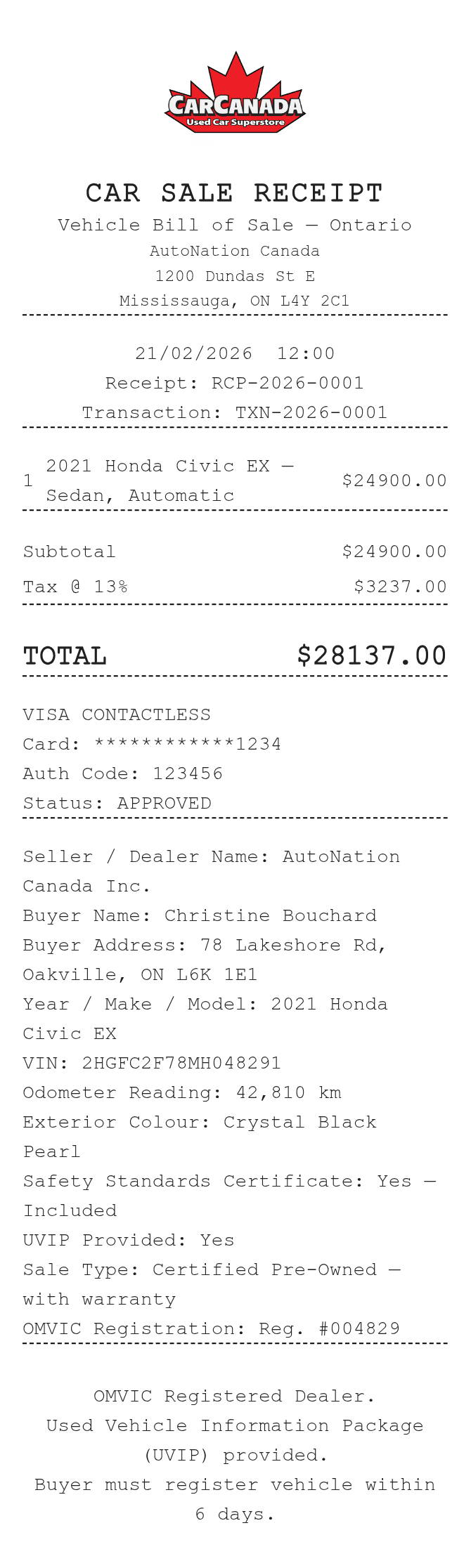
Add the buyer, seller, vehicle and payment details to a Canadian car-sale receipt. The starting example uses Ontario fields; review them for your transaction before downloading.
Last updated
Know what the Canadian example includes
This layout uses Canadian dollars and has space for the vehicle year, make, model, VIN, color and odometer reading. It also includes Ontario-specific labels for a safety certificate, UVIP and OMVIC registration. Those entries are editable notes, so check them instead of treating the opening example as a completed vehicle record.
What a Canadian car sale receipt needs to show
Vehicle paperwork is set by each province, so start with the rules where the car will be registered. In Ontario, the government's used-vehicle guide says a bill of sale for a new or used vehicle must include the VIN; the make, year and power source (gas, diesel or electric); the body type, color and model; the purchase price, with taxes collected and the HST/GST number if applicable; the seller's name, address and signature; the buyer's name and address; and the sale date. It must be an original, though it can be handwritten, and a bill of sale completed by a company or dealer must be on its letterhead.
Sales tax works differently from a typical US car sale receipt. In an Ontario private sale, the buyer pays the tax when registering as the new owner, not to the seller. In most cases that is 13% retail sales tax on the purchase price or the vehicle's Canadian Red Book wholesale value, whichever is greater, and a buyer who paid less can have the vehicle appraised. A gift to a close family member can be exempt with a sworn statement. The seller must give the buyer a Used Vehicle Information Package, which shows any money owing on the vehicle, and the buyer must register within 6 days of the purchase.
When a dealer's GST/HST details matter
If the buyer is a GST/HST registrant claiming input tax credits, the CRA sets what the receipt or invoice must show. For a sale of $500 or more, that includes the supplier's name, the invoice date, the total, the GST/HST charged or a statement that it is included, the supplier's GST/HST registration number, the buyer's name, a brief description and the terms of payment.
Most businesses must register for GST/HST once their taxable sales go over $30,000 in four consecutive calendar quarters or in a single quarter. Ontario will accept a pre-printed bill of sale with a handwritten HST/GST number.
Details to replace in the sample
| Section | Details |
|---|---|
| People | Seller or dealer name, buyer name and buyer address |
| Vehicle | Year/make/model, VIN, exterior color and odometer |
| Sale description | An editable Sale Type field |
| Ontario notes | Safety certificate, UVIP and OMVIC registration entries |
| Amounts | Vehicle line amount, tax percentage and payment details |
Related receipt guides
Preparing your sale record
- Make the vehicle description in the item row agree with the dedicated vehicle fields.
- Enter the full charge in Line amount. Tax % is added to the subtotal; the editor does not choose a tax rate from your province or sale type.
- Replace the example certificate, registration and warranty statements with information you can support.
- Review the authority’s requirements separately. In Ontario, the official used-vehicle guide explains the bill of sale and other documents involved.
FAQs
Official sources
- Ontario: buy or sell a used vehicle
- Ontario - Buy or sell a used vehicle in Ontario
- CRA - Input tax credits and the records you need
- CRA - When to register for and start charging the GST/HST