Car Valet Receipt Template
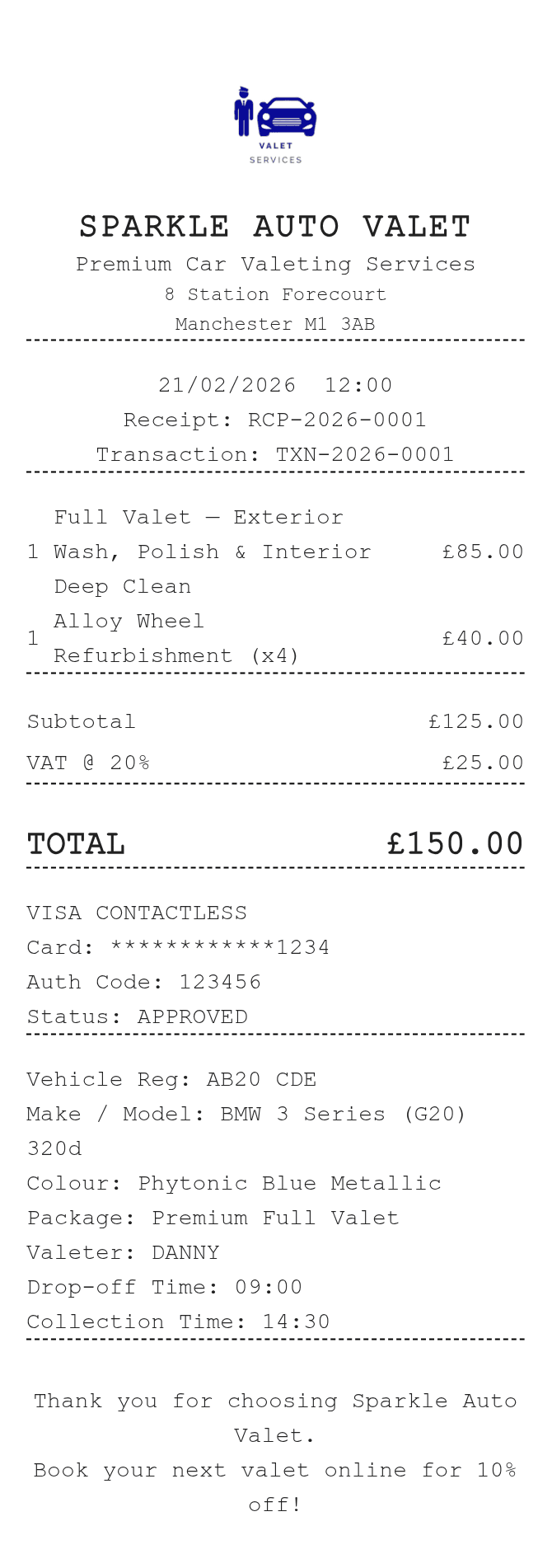
Create a receipt for a valeting package with the vehicle, drop-off and collection details. Edit the cleaning charges and payment information, then download the finished layout.
Last updated
A receipt for vehicle cleaning and valeting
Here, valet means a vehicle-cleaning service. The example combines a full valet with an additional wheel service and has separate fields for the package, valeter and vehicle. Drop-off and collection times help identify the visit without putting those details into every service description.
What a car valeting receipt should record
A car valeting receipt is the customer's record of what was cleaned, when and for how much. A useful one names the business and its contact details, the date of the work, the vehicle registration and the package chosen, plus any extras such as wheel cleaning, with a price for each charged item and a clear total. If the valeter is VAT registered, HMRC guidance says a retailer's VAT invoice for £250 or less must show the business name, address and VAT registration number, the time of supply, a description of the services and, for each VAT rate, the total including VAT and the rate.
Larger jobs need more. HMRC says a full VAT invoice is required when the transaction is over £250, or when a customer asks for one on a smaller sale, and a business can face a penalty for refusing a VAT invoice to a taxable person who asks. A card payment slip can double as a retailer's VAT invoice if the business adds its VAT number, the VAT rate and a description of the work. A UK-based valeter must register for VAT only when taxable turnover for the last 12 months goes over £90,000, or is expected to in the next 30 days, so many small and mobile valeters charge no VAT.
Keeping valeting receipts for tax records
If you run a valeting business as a sole trader, GOV.UK says you must keep records of all sales and income, with proof such as sales invoices, till rolls, bank slips and receipts for goods and stock. Keep them for at least 5 years after the 31 January Self Assessment deadline for the tax year. For example, records for a 2022 to 2023 return sent by 31 January 2024 must be kept until at least the end of January 2029.
A VAT-registered customer reclaiming VAT on cleaning a business vehicle needs a VAT invoice from a registered valeter. When a less detailed invoice doesn't show VAT separately, the VAT is the VAT fraction of the total, which is one-sixth at the 20% rate.
What this valeting layout records
| Section | Details |
|---|---|
| Vehicle | Registration, make/model and color |
| Package | The package name and valeter |
| Visit times | Drop-off and collection times as separate text entries |
| Cleaning charges | Item descriptions, quantities and full line amounts |
| Business and payment | Editable business header, VAT percentage and payment details |
Related receipt guides
Before you save the receipt
- Replace the package name and list what was charged. Keep included treatments within the package price and add only separately paid extras.
- Enter the full amount for each row, including any quantity shown. The editor sums line amounts rather than multiplying by quantity.
- Check that the drop-off, collection and main receipt times all describe the intended visit.
- Read the footer offer and replace it with your own message if it does not apply. Use the download arrow for format and paper-size options.
FAQs
Official sources
- HMRC - VAT guide (VAT Notice 700), simplified and retailers' VAT invoices
- GOV.UK - Register for VAT
- GOV.UK - Business records if you're self-employed