Transport Receipt Template with Manual Fare and Tax
Enter the transport company, service and payment references. Fill in the fare, tax amount and final total separately, then check the finished receipt.
Last updated
Write down one transport payment
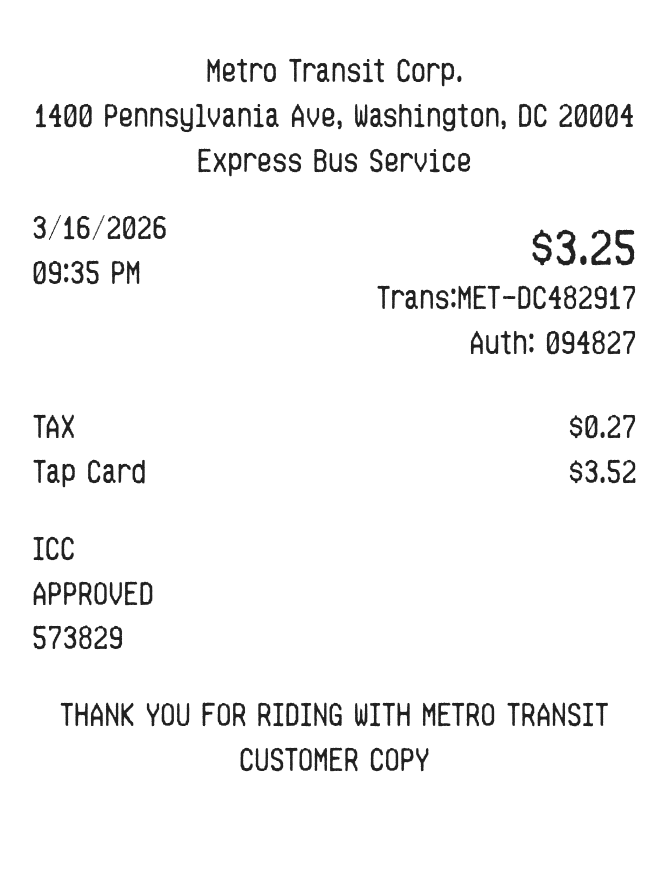
The transport receipt template is a compact service-payment layout. Company and branch details sit above the service, date and time, with transaction and authorization references below the amounts. Fare, tax and total are independent entries, which lets you transcribe a breakdown from an existing record.
What a transport receipt needs for expense records
A transport receipt is most useful when it answers the four questions the IRS asks of business expense evidence. IRS Publication 463 says documentary evidence is ordinarily adequate if it shows the amount, date, place and essential character of the expense. For a fare, that means the provider's name, the date and time, where the trip started and ended or which service was used, and the amount paid, with any tax shown separately. A transaction or authorization reference helps you match the receipt to a card statement later.
Business purpose matters too, because a ride is only deductible in the right context. Publication 463 lets you deduct local transportation for getting from one workplace to another, visiting clients or customers, or going to a business meeting away from your regular workplace. It does not allow the cost of a bus, subway or taxi between home and your main or regular place of work, which counts as personal commuting no matter how far you travel. Note the purpose on the transport receipt or in your log.
Keeping transport receipts the IRS way
The IRS generally expects receipts, canceled checks or bills to support travel expenses, but it lists exceptions. You don't need documentary evidence for an expense, other than lodging, under $75, or for a transportation expense where a receipt isn't readily available. You still need a record of the amount, date, place and purpose. Publication 463 also lets you make one daily entry for reasonable categories such as taxi fares.
Record each trip at or near the time it happens; the IRS says a weekly log counts as timely kept. Keep the records that support a deduction for 3 years from the date you file the return that claims it.
Amounts and references to check
| Section | Details |
|---|---|
| Provider | Edit the company name, branch address and transport-service description. |
| Timing | Enter the printed date and time. |
| Fare and tax | Type the fare amount and the money amount of tax; tax is not a percentage. |
| Total | Enter the final total separately and check it against the fare plus tax. |
| Payment record | Edit the card or payment type, transaction ID and authorization references. |
Related receipt guides
Reconcile the three amounts
- For a fare of 3.25 and tax of 0.27, the matching total is 3.52. The form will not do that addition for you.
- An approval or transaction reference is printed text. Entering it does not verify a payment.
FAQs
Official sources
- IRS - Publication 463 (2025), Travel, Gift, and Car Expenses
- IRS - Publication 15-B (2026), Employer's Tax Guide to Fringe Benefits