Cash Taxi Receipt Template
Fill in the driver, cab and trip details, then enter the fare, extras and tip. Check the journey totals in the preview and download the receipt.
Last updated
This cash receipt layout is built around a taxi trip
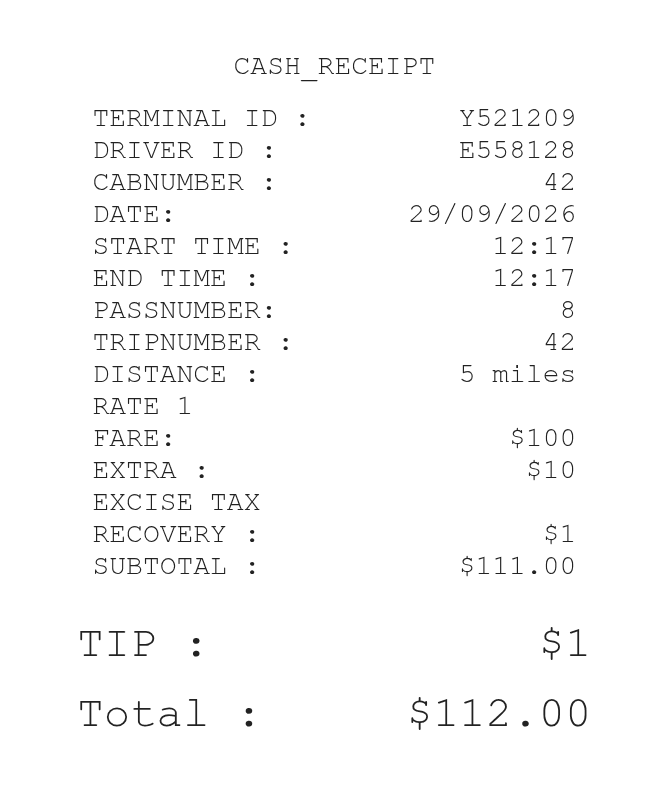
The Cash template uses a taxi-style form with driver and cab identifiers, start and end times, distance and fare details. Choose it for a journey record when those fields fit your needs. For a general acknowledgment with payer and payment-purpose fields, the payment receipt template linked below is a better starting point.
What a cash taxi receipt should record
A cash receipt is often the only record of a taxi trip, because a cash payment leaves no card statement behind. New York City's Taxi and Limousine Commission rules give a useful checklist. At the end of a taxi trip the driver must offer a receipt, and it must state the date, time, medallion or Street Hail Livery license number, trip number, total fare, tolls, surcharges, extras, the tip if paid by card, the driver's hack license number and the 311 complaint number. Other cities set their own rules, but the same details make any cash receipt easy to match to a trip.
For business travel, IRS Publication 463 says you generally need documentary evidence such as receipts, but not for an expense other than lodging under $75, or for a transportation expense when a receipt isn't readily available. You still need a record of the amount, time, place and business purpose. Evidence is adequate when it shows the amount, date, place and essential character of the expense. On the business side, IRS Publication 583 lists receipt books and cash register tapes as records of gross receipts, and petty cash slips as records of small cash payments.
How to get a receipt for a cash taxi fare
Ask for the receipt before you leave the cab. The NYC TLC says it's a good idea to always take one, because the medallion number printed on it lets the TLC identify the driver and taxi if you leave property behind or want to file a complaint or compliment. With a cash fare there's no card record to fall back on, so keep the paper copy with your expense records.
Businesses that take cash have a separate duty for large payments. The IRS says a trade or business that receives more than $10,000 in cash in one transaction or related transactions must file Form 8300 within 15 days, give the payer a written statement by January 31 of the following year, and keep copies for at least five years.
Trip information and charges
| Section | Details |
|---|---|
| Journey | Date, start time, end time and trip number |
| Vehicle and driver | Cab number, driver ID and terminal ID |
| Distance | Distance, unit and rate shown as separate entries |
| Fare | Base fare, extra fare, recovery amount and tip |
| Payment | Editable payment details printed beneath the totals |
Related receipt guides
How the total is worked out
- Enter the journey details and check that the start and end times match your record.
- Set the fare directly. Changing distance or rate does not calculate a new fare in this form.
- Review the subtotal, which adds fare, extra fare and recovery. The tip is then added to the final total.
- Inspect the payment details and the full receipt before choosing a download format.
FAQs
Official sources
- NYC TLC - Rules, Chapter 80 (Drivers), Section 80-16(d) passenger receipts
- NYC TLC - Passenger frequently asked questions
- IRS - Publication 463, Travel, Gift, and Car Expenses
- IRS - Publication 583, Starting a Business and Keeping Records
- IRS - Form 8300 reference guide