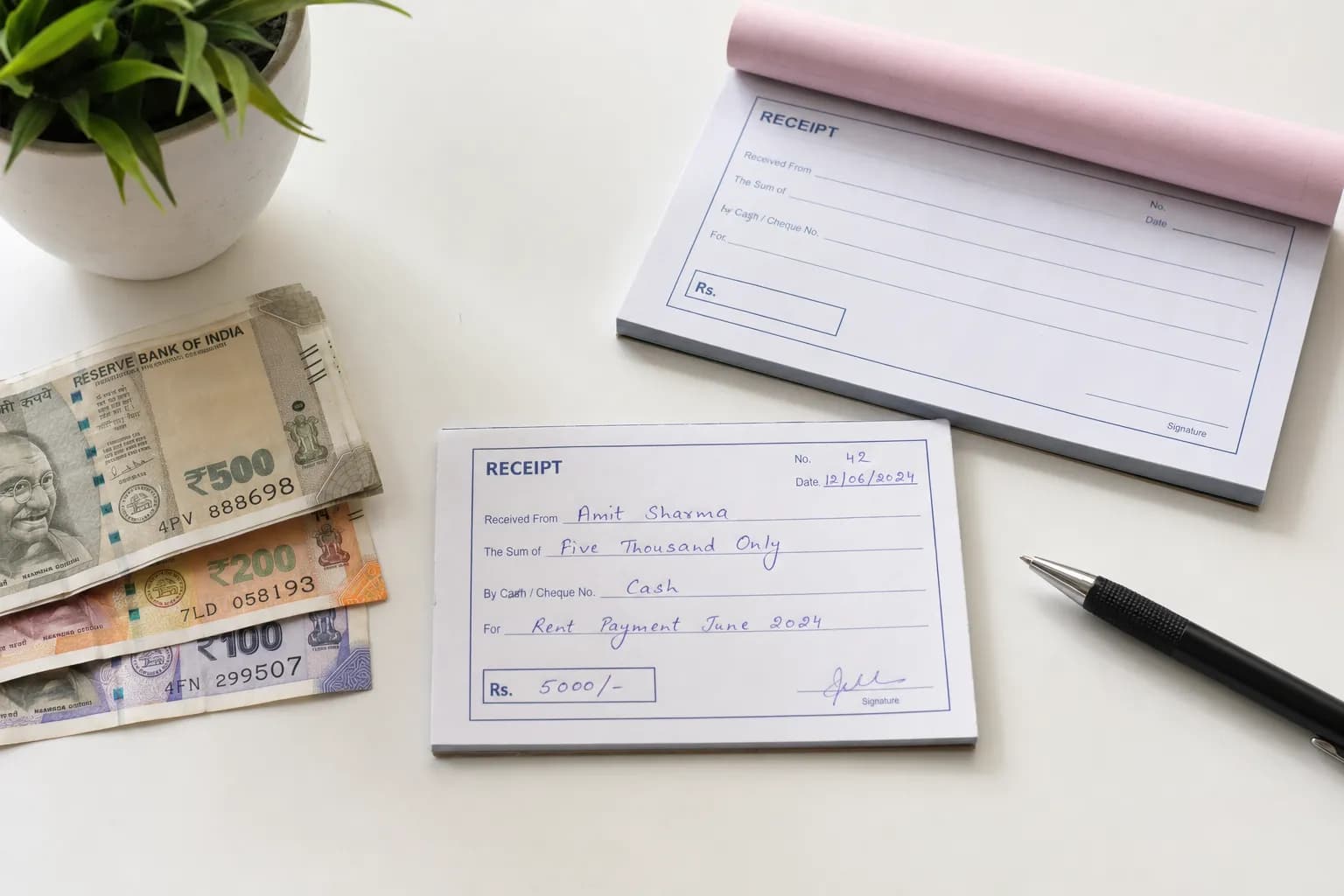
A cash-payment receipt should identify the date, payer, payee, amount and purpose. Signatures can help acknowledge the transaction. Keep supporting records too; a receipt is not necessarily the only evidence of payment.
This guide shows a practical format for a receipt for cash payment. Legal and tax requirements depend on the transaction and location; no template guarantees compliance.
Why Cash Payment Receipts Matter
Cash may leave fewer automatic records than a card payment, so both parties should keep evidence of the transaction:
- Payer risk: Without a receipt, resolving a payment dispute may be harder; retain any other evidence of the transaction.
- Payee risk: If you cannot prove the income was received, IRS reporting becomes harder. Tax authorities may also question undocumented income.
- Mutual risk: Disputes about what the payment was for (rent vs deposit, full payment vs partial) require documentation to resolve.
Some business cash transactions have separate reporting requirements. Consult the IRS Form 8300 guidance for the scope, aggregation rules and exceptions; issuing a receipt does not replace required reporting.
What a Cash Receipt Must Include
| Element | Include for clear records? | Example |
|---|---|---|
| Date of payment | Yes | May 20, 2026 |
| Receipt number | Recommended | R-2026-001 |
| Payer name and contact | Yes | John Smith, 555-123-4567 |
| Payee name and contact | Yes | Jane Doe, jane@email.com |
| Amount paid (written and numeric) | Yes | $500.00 (Five hundred dollars) |
| Description of payment purpose | Yes | "Rent for May 2026, 123 Main St" |
| Payment method | Yes | "CASH" |
| Signature of payee (receiving payment) | Yes | Handwritten |
| Signature of payer (optional but recommended) | Recommended | Handwritten |
| Balance remaining (if partial payment) | If applicable | "Balance due: $300" |
The written and numeric amounts protect against alteration. If "$500" is written, someone could add a zero to make it "$5000." Writing "Five hundred dollars and 00/100" prevents this.
Cash Receipt Format Examples
Simple Handwritten Cash Receipt
RECEIPT
Date: May 20, 2026
Receipt #: 001

Received from: John Smith
The sum of: Five hundred dollars and 00/100 ($500.00)
For: Rent payment for May 2026
Address: 123 Main Street, Apt 4

Payment method: CASH
Balance: $0.00 (paid in full)

Received by: Jane Doe (Landlord)
Signature: ___________________
Payer signature: ___________________
Detailed Service Cash Receipt
SMITH HANDYMAN SERVICES
123 Oak Street, Springfield, IL
(555) 123-4567

RECEIPT #SH-2026-042
Date: May 20, 2026

Customer: John Doe
Address: 456 Maple Ave

Service performed:
- Kitchen sink leak repair (2 hours @ $45/hr): $90.00
- Replacement P-trap parts: $25.00
Subtotal: $115.00
Tax (8.25%): $9.49
TOTAL: $124.49

Payment received: $124.49 CASH
Balance due: $0.00

Received by: John Smith
Signature: ___________________
Customer signature: ___________________
For common service types, browse home services receipt templates, general services templates, and automotive receipt templates.
Cash Receipt for Rent Payment
Rent receipts have specific legal importance:
- Check the applicable rental and tax rules for the transaction and location
- Proof of timely payment in eviction defense
- Documentation for tenant insurance claims
- Evidence of payment history for future rental applications
| Useful Rent Receipt Details | Why |
|---|---|
| Date paid | Establishes timely vs late payment |
| Period covered | e.g., "May 2026 rent" vs deposit |
| Property address | Identifies the rental unit |
| Landlord/property manager name | Who received the payment |
| Tenant name | Who made the payment |
| Amount paid | Numeric AND written |
| Balance remaining | If partial payment |
| Landlord signature | Validates the receipt |
Check your local housing authority’s official guidance for rent-receipt requirements. Request an accurate receipt and keep the payment record.
Cash Receipt for Personal Sale (Private Party)
Used cars, furniture, electronics, sports equipment — private party sales need receipts for both buyer protection and tax reporting:
Transaction Details to Include
- Date of sale
- Description of item (year, make, model, VIN for vehicles)
- Sale price (written and numeric)
- "As-is, no warranty" notation (standard for private sales)
- Seller and buyer names and addresses
- Both signatures
Vehicle-Specific Requirements
- VIN (Vehicle Identification Number)
- Odometer reading at time of sale
- Title number (if applicable)
- "Sold as-is, where-is" language
- Check the relevant motor-vehicle authority’s official title and bill-of-sale requirements; notarization rules vary
A bill of sale can document a vehicle transaction, but it may not complete the title transfer. Follow the relevant motor-vehicle authority’s title and registration requirements.
Cash Receipt for Tax Purposes
For business owners receiving cash payments:
- Record business cash receipts accurately; whether a receipt is taxable income depends on the transaction
- Issue receipts to customers so they can claim deductions if applicable
- Keep duplicate copies for your records (use carbon receipt books or photograph)
- Track cash separately from card/check income for tax filing
- Check whether a business cash transaction triggers Form 8300 reporting under the IRS rules
For business owners spending cash:
- Request and retain the seller’s receipt with other available payment evidence
- Note the business purpose on the receipt immediately
- The $75 exception is limited to specific documentary-evidence rules in IRS Publication 463; it is not an exemption from substantiating every smaller business purchase. See our IRS receipt requirements guide.
- Document smaller expenses as required by the relevant rules; do not assume a written log is always sufficient
Digital Cash Receipts (Best Option)
Handwritten receipts work but have drawbacks: handwriting must be legible, no automatic backup, easy to lose. Digital receipts solve these issues.
The receipt generator creates professional cash payment receipts with:
- Common transaction fields formatted for you
- Receipt numbering (sequential)
- Date, payer, payee, amount, purpose, payment method
- Balance tracking for partial payments
- PDF download for email/print/storage
- Both parties can save a digital copy
For different transaction types, use industry-specific templates: services, home services, automotive. Each includes the relevant fields for that transaction type.
Carbon Receipt Books (Traditional Option)
Carbonless receipt books cost $5-$15 at any office supply store. Each receipt is duplicated with carbon paper or NCR (no carbon required) paper. The white original goes to the payer; the yellow or pink copy stays in the book for your records.
Advantages:
- No technology needed
- Sequential numbering built in
- Both parties immediately get a copy
- Physical record book serves as a journal
Disadvantages:
- Handwriting must be legible
- No digital backup
- Manual tax calculation required
- Easy to lose the book
For small businesses doing 5-20 cash transactions per week, carbon receipt books are a reasonable backup to digital receipts.
Common Cash Receipt Mistakes
- Writing the amount only numerically. Always include the written form to prevent alteration.
- Missing the purpose of payment. "$500 received" is much weaker than "$500 received for May 2026 rent."
- No payer information. If you cannot identify who paid, the receipt has limited value as proof.
- Single signature. The payee should sign at minimum. Having both parties sign adds verification.
- No date. Surprisingly common, undated receipts are nearly useless for legal or tax purposes.
- No copy for payer. The whole point is mutual documentation. Make sure they get a copy.
Cash Receipt FAQs
How do I write a receipt for cash payment?
Include 8 elements: date, receipt number, payer name, payee name, amount (written and numeric), purpose of payment, payment method ("CASH"), and signature of the recipient. For high-value transactions, both parties should sign. Use a carbon receipt book or the receipt generator for clean, properly formatted versions.
Is a handwritten cash receipt legally valid?
A handwritten receipt can document a transaction, but legal sufficiency, signatures and any notarization requirements depend on the location and type of sale. Check those requirements for a high-value transaction.
Do I need a receipt for small cash payments?
The $75 exception is limited to specific documentary-evidence rules in IRS Publication 463; it is not an exemption from substantiating every smaller business purchase. See our IRS receipt requirements guide. Request an accurate record from the seller regardless of payment method.
Can I create a receipt after I received the cash?
Yes. The receipt can be created retroactively, but should be dated as of when the payment was actually received (not when the receipt was created). Note "Receipt issued [later date] for payment received [original date]" if there is a significant gap. Both parties should sign or initial to acknowledge the after-the-fact documentation.
What is the difference between a cash receipt and a regular receipt?
A cash receipt specifically documents cash payment with payer/payee identification. A regular receipt from a store documents a transaction but does not always require identifying the payer (you do not put your name on a Walmart receipt). Cash receipts emphasize the parties involved because cash transactions have no automatic card or bank record. See our receipt vs invoice guide for related differences.
Do landlords have to provide receipts for cash rent payments?
Rent-receipt requirements vary by jurisdiction. Request a receipt for cash rent and check the relevant official housing authority for the rules that apply; this guide does not establish a state-by-state legal requirement.
Can the receipt generator create cash payment receipts?
Yes. The receipt generator creates professional cash payment receipts with common fields: date, payer, payee, amount, purpose, payment method, balance, and signature lines. Download as PDF for both parties. For service-specific formats, browse services templates or home services templates.
What if I cannot remember the exact date of a past cash payment?
Use the closest approximate date and note "approximate date" on the receipt. Combine with any supporting documentation you have (witness, related transactions on your bank statement, etc.). For tax or legal purposes, approximate dates with supporting evidence are better than no documentation at all. See our small business receipt guide for record-keeping best practices.