Oil Change Receipt Template
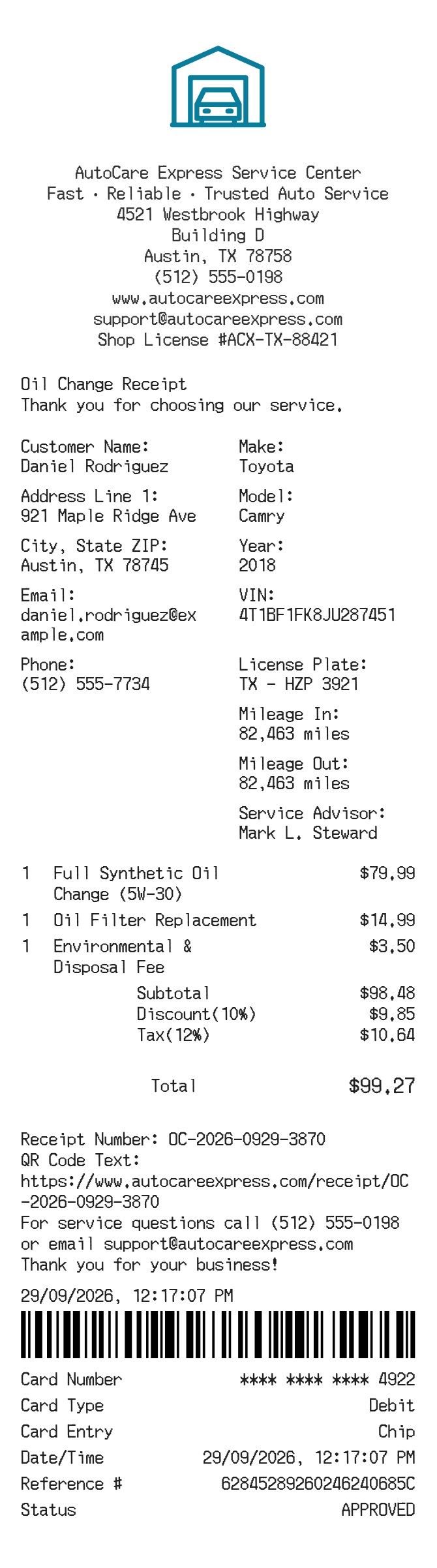
Record the oil-change work, vehicle details and mileage in an editable receipt. Review the service rows, payment and notes before downloading.
Last updated
Make the maintenance record identifiable
Use the vehicle’s year, make, model, VIN and plate to tie the oil-change receipt to the right car. Mileage-in and mileage-out rows are available beside the service-advisor details. The example includes an oil change, filter and disposal fee; edit that breakdown to match how the work was billed.
What an oil change receipt should list
An oil change receipt is a small repair record. The FTC's auto repair advice says to get a completed repair order describing the work done, listing each repair, the parts supplied, the cost of each part, the labor charges and the odometer reading when you brought the vehicle in. For an oil change, that means the oil and quantity, the filter, any other parts, the labor or package price and the mileage. California's Bureau of Automotive Repair treats oil and other fluid changes as preventative maintenance, and a shop must still give the customer an invoice when the work is done.
In California, that invoice must show the shop's BAR registration number with its business name and address, an itemized list of services and parts with a price for each, and whether each part is new, used, reconditioned or rebuilt. It then gives a subtotal for labor, a subtotal for parts, any sales tax and the total. A toxic waste disposal fee must be itemized along with the shop's EPA identification number, and generic shop supplies or miscellaneous parts may not be billed as a separate charge. Shops must keep invoices, estimates and work orders for at least three years. Other states set their own rules.
Keeping oil change receipts for warranty and taxes
Keep every oil change receipt with your vehicle records. The FTC says you don't have to use the dealer for repairs or maintenance to keep a warranty in effect, but the warranty company could ask for your maintenance records. For a vehicle service contract, the FTC advises keeping service records and receipts to show you maintained the vehicle, because skipping recommended maintenance might void the contract.
For business driving, IRS Publication 463 lists oil among actual car expenses. If you use the standard mileage rate for a year instead, you can't also deduct oil, maintenance or repairs. The IRS business rate for 2026 is 72.5 cents a mile for January 1 to June 30 and 76 cents a mile for July 1 to December 31.
What belongs in each section
| Section | Details |
|---|---|
| Vehicle information | Make/model/year, VIN, plate and mileage entries |
| Service rows | Oil grade and service description, filter or other separately billed items |
| Summary | Editable discount, tax and total lines |
| Payment | Cash/card details and references |
| Notes | Service messages, receipt reference and footer text |
Related receipt guides
Check the maintenance details
- Enter the oil grade and work from the service record. The template does not select an oil or filter for the vehicle.
- Check whether the filter and disposal fee are already included in a package before adding separate charges.
- Update both mileage entries and any service notes. A sample inspection statement does not confirm that an inspection occurred.
- Review footer links before export. A URL typed into a note does not create a hosted receipt or a service-history entry.
FAQs
Official sources
- FTC - Auto Repair Basics
- FTC - Auto Warranties and Auto Service Contracts
- California Bureau of Automotive Repair - Write It Right
- IRS Publication 463 - Travel, Gift, and Car Expenses
- IRS - Standard mileage rates