Garage Receipt Template
Itemize garage work and record the vehicle, mileage and mechanic. Add any next-visit notes, check the figures and download your receipt as PDF or PNG.
Last updated
Keep completed work separate from future recommendations
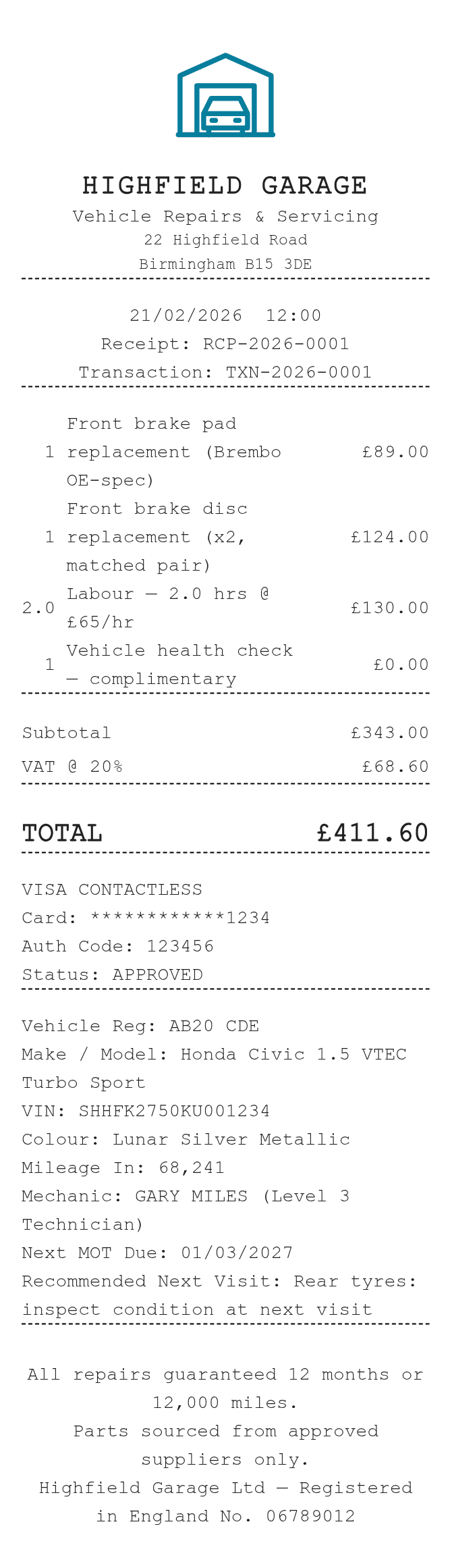
The garage layout has item rows for the job that was billed and a separate Recommended Next Visit field. That separation helps distinguish work already paid for from something the mechanic suggests checking later. Vehicle registration, VIN, mileage and mechanic details sit alongside the payment record.
What a UK garage receipt should show
A garage receipt is the record of what was done to your vehicle and what you paid. It helps to identify the car by registration and mileage, date the visit, and list parts and labor on separate lines. If the garage is VAT-registered, HMRC rules for a retailer's invoice of £250 or less, including VAT, require its name, address and VAT registration number, the time of supply, a description of the work, and the total including VAT for each rate. For a bill over £250, the garage must give a full or modified VAT invoice if you ask.
The receipt also backs up your Consumer Rights Act 2015 rights. Every service contract includes a term that the trader must work with reasonable care and skill. If no price was agreed in advance, you only have to pay a reasonable price. When a repair falls short, you can require the garage to do the work again within a reasonable time, at its own cost for labor and materials. If that is impossible or does not happen in a reasonable time, you can claim a price reduction, refunded within 14 days of the garage agreeing to it.
How to get copies of garage and MOT records
For a repair invoice, ask the garage that did the work. MOT results are kept centrally. The GOV.UK MOT history service shows whether each test passed, the recorded mileage and when the next MOT is due. For tests in England, Scotland or Wales you can download current and previous certificates, and car results go back to 2005.
Self-employed drivers can claim repairs and servicing as allowable expenses, unless they use flat-rate simplified mileage instead of actual costs. HMRC requires records for at least 5 years after the 31 January filing deadline. For the 2025 to 2026 tax year, filed by January 31, 2027, keep them until at least the end of January 2032.
Fields for a garage visit
| Section | Details |
|---|---|
| Vehicle | Registration, make/model, VIN and color |
| Workshop visit | Mileage in and mechanic name |
| Billable work | Parts, labor and other item descriptions with full line amounts |
| Follow-up | Recommended next visit and next MOT due |
| Receipt | Business header, date, VAT percentage and payment details |
Related receipt guides
Check labor and follow-up notes
- Enter the complete labor charge in Line amount. For two hours at £65, use £130.00 as the line amount and describe the rate in the item text.
- Quantity is displayed but is not multiplied again in this layout. Use a full amount for parts rows too.
- Keep recommendations out of the billed item list unless they were actually charged.
- Review the VAT setting, MOT date and footer guarantee text. Those defaults do not determine the vehicle’s condition or the garage’s terms.
FAQs
Official sources
- Consumer Rights Act 2015, sections 49-56 (services)
- HMRC - Record keeping for VAT (VAT Notice 700/21), section 4.4
- GOV.UK - Getting an MOT: costs, timing and results
- GOV.UK - Check the MOT history of a vehicle
- GOV.UK - Car, van and travel expenses if you're self-employed
- GOV.UK - How long to keep business records