Refund Receipt Template
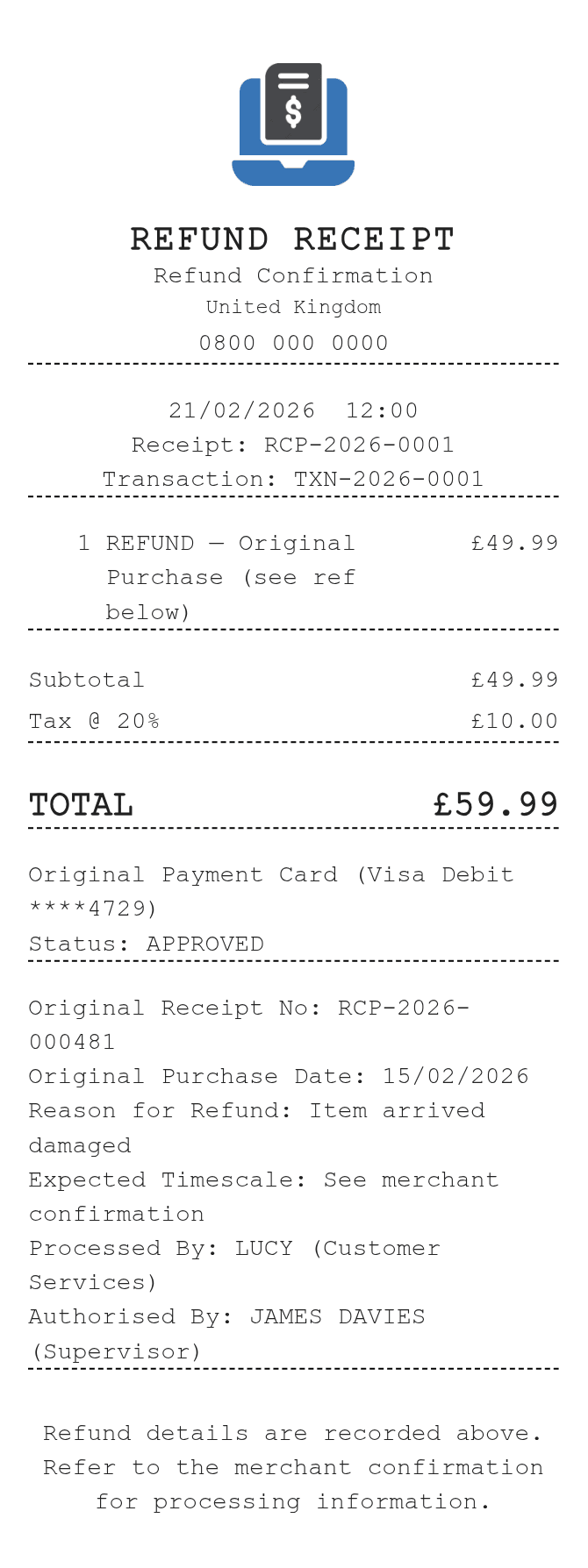
Record the amount returned, the original receipt reference and the reason for the refund. Add the recorded refund method and any timescale supplied by the merchant.
Last updated
Connect the refund to the original purchase
A refund receipt needs to show which earlier payment it relates to. This template has dedicated fields for the original receipt number and purchase date, plus the refund reason and staff references. Describe the returned item in the row so a partial refund is clear without reopening the original order.
What a refund receipt records and the rules behind it
A refund receipt is the merchant's record that money, or credit, went back to the customer for an earlier purchase. It is most useful when it names the original receipt or order, the date of the return, the items or portion refunded, the amount and tax returned, and the method used. Store policy decides most refunds, but some states set disclosure rules. California Civil Code 1723 says a retailer whose policy does not give full cash or credit refunds or equal exchanges for at least seven days after purchase, when proof of purchase is shown, must display that policy conspicuously. If it doesn't, the buyer can recover the purchase amount by returning the goods within 30 days.
Card refunds follow federal timing rules. Under Regulation Z, 12 CFR 1026.12(e), a merchant that accepts a return to be credited to a credit card account must send a credit statement to the card issuer within 7 business days, and the issuer must credit the account within 3 business days of receiving it. The same section says a merchant that routinely gives cash refunds to cash customers must offer card users credit or cash refunds too, unless it disclosed at the time of sale that refunds aren't given. The date on the refund receipt is the starting point for tracking that credit.
Keeping a refund receipt with the original purchase
Store the refund receipt with the original receipt or order confirmation, then check that the credit appears on your card or bank statement for the same amount. If the credit doesn't show up, the date, amount and original receipt number on the refund receipt give the merchant and your card issuer what they need to trace it.
For mail, internet and phone orders the merchant cancels or can't ship, the FTC's Mail, Internet, or Telephone Order Merchandise Rule requires refunds within seven working days for cash, check, money order or third-party credit card payments, and within one billing cycle when the seller itself extended the credit.
Record what was returned
| Section | Details |
|---|---|
| Original purchase | Copy the receipt number and purchase date. |
| Refund amount | Enter the amount being refunded for each item. |
| Reason | State the recorded reason, such as damage or an overcharge. |
| Refund method | Name the card, cash or other method used. |
| Processing notes | Record staff details and the timescale actually provided. |
Related receipt guides
Avoid adding tax twice
- Tax % adds a percentage to the refund line amounts. If a line already contains the entire tax-inclusive refund, a further tax percentage would increase it again.
- An expected timescale is a note supplied by you. The page does not issue a refund, check bank settlement or know when funds will arrive.
FAQs
Official sources
- California Civil Code 1723, Retail refund policy disclosure
- CFPB - Regulation Z, 12 CFR 1026.12, Special credit card provisions
- FTC - Business guide to the Mail, Internet, or Telephone Order Merchandise Rule