Deposit Receipt Template for Canada
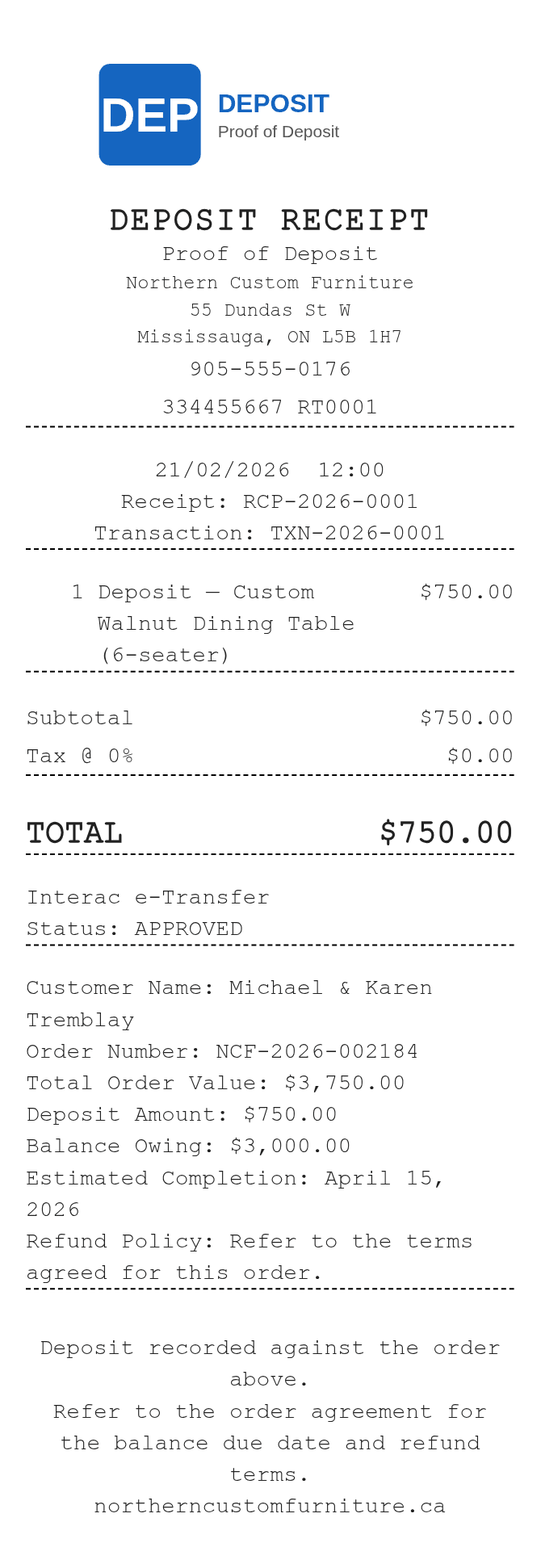
Document a customer order deposit in Canadian dollars. Add the order value, balance owing and estimated completion date, then check the payment record before saving.
Last updated
Keep an order deposit tied to its order
This deposit receipt template for Canada has a customer name and order number, plus space for the full order value and the amount still owing. It suits a deposit on work or goods due later, such as the custom furniture order in the example. Enter the payment received in the item list.
How order deposits work under GST/HST rules
The CRA's instruction to businesses is direct: do not collect GST/HST when a customer gives you a deposit towards a taxable purchase. You collect the tax when you apply the deposit to the purchase price. That is why a Canadian deposit receipt for a custom order usually records the amount received without a tax line, and the GST/HST appears on the final invoice. If the customer does not complete the purchase and loses the deposit, the forfeited amount becomes subject to GST/HST. The CRA calculates GST on it as the forfeited amount times 5/105, and HST as 13/113 or 15/115 depending on the rate.
Business customers who claim input tax credits need certain details on their paperwork. Under the CRA's chart, every receipt needs the supplier's business or trading name, the date and the total paid or payable. From $100 to $499.99, it must also show the GST/HST charged (or that prices include it), the status of each supply when taxable and exempt items are mixed, and the supplier's GST/HST registration number. At $500 or more, add the buyer's name, a brief description and the terms of payment. A registrant customer can claim an input tax credit for GST/HST paid on a forfeited deposit.
What an Ontario order agreement with a deposit must show
In Ontario, the Consumer Protection Act, 2002 requires a future performance agreement over $50 to be in writing and delivered to the consumer. Ontario Regulation 17/05 lists what it must include, such as the consumer's and supplier's names, the supplier's phone number and business address, a fair description of the goods, itemized prices including taxes and shipping, the total, the payment terms and the delivery dates. If the consumer does not receive a copy that meets these requirements, the Act lets them cancel within one year.
Keep the deposit receipt with that written agreement, and record each later payment against the same order number. Other provinces have their own consumer protection laws, so check the rules where the customer lives.
Fill in the order summary
| Section | Details |
|---|---|
| Customer and order | Match the name and order number to your order record. |
| Deposit line | Describe the order and enter the complete amount received. |
| Order value and balance | Enter both amounts manually and check the difference. |
| Completion | Use the estimated completion date agreed with the customer. |
| Refund terms | Replace the sample policy with the terms for this order. |
Related receipt guides
Keep the written amounts consistent
- Deposit Amount and Balance Owing do not follow changes to the item rows. Review them when adding a further payment or changing the order value.
- The Tax % control adds one percentage to the item subtotal. It does not choose a Canadian tax rate or separate tax already included in a payment. Use figures from the transaction record.
FAQs
Official sources
- Canada Revenue Agency - GST/HST in special cases (deposits)
- Canada Revenue Agency - Input tax credits (information requirements)
- Ontario e-Laws - Consumer Protection Act, 2002
- Ontario e-Laws - O. Reg. 17/05 (General)