Business Receipt Template
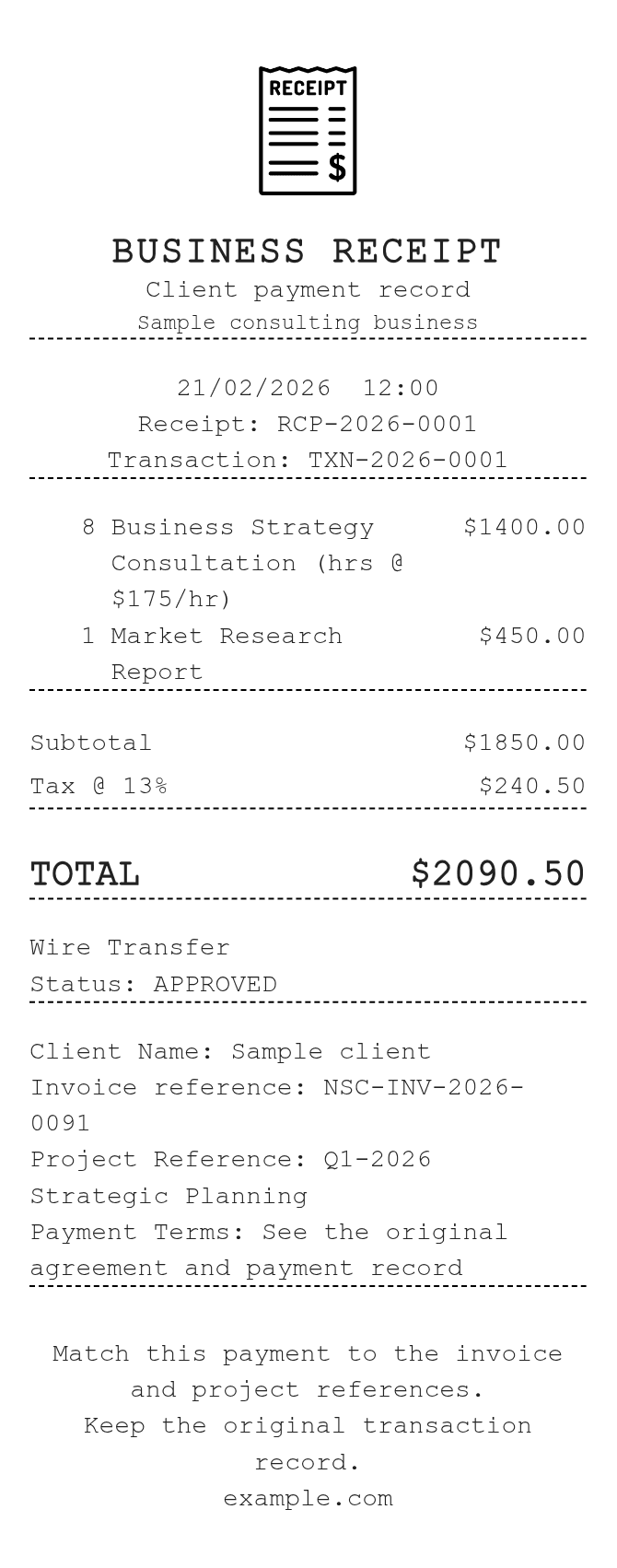
Record a client payment with the invoice and project references. Enter service descriptions, complete line amounts and the payment details, then download.
Last updated
Connect the payment to the work
This business receipt has space for the client, invoice reference and project reference alongside an itemized service record. Use those references to match the payment to your existing records. The example includes hourly work, but the line amount must contain the full charge for those hours.
What a Canadian business receipt should show for GST/HST
The CRA says businesses must let customers know whether GST/HST applies to a purchase and whether it is included in the price or added separately. Receipts, invoices, contracts or posted signs can do this. The document has to show the GST/HST rate that applies, and either the amount payable and the GST/HST as separate lines or a clear statement that the total includes GST/HST. Where HST applies, show the total HST rate rather than separate federal and provincial parts. The rate itself depends on the place of supply, and where PST is charged, GST is calculated on the price without the PST.
Clients who are GST/HST registrants need more detail to claim input tax credits. Every business receipt needs your business or trading name, the invoice date and the total. From $100 to $499.99, the CRA also requires the GST/HST charged or a statement that it is included, and your GST/HST registration number. At $500 or more, add the client's name, a brief description of the services and the terms of payment. The CRA tells purchasers to confirm a supplier's GST/HST account number, and most registrants have up to four years to claim an input tax credit.
Registering and keeping business receipt records in Canada
You do not have to register for GST/HST while you are a small supplier, meaning your taxable supplies do not exceed $30,000 over four consecutive calendar quarters, though you may register voluntarily. If you exceed $30,000 in a single calendar quarter, the CRA says you must charge GST/HST on the supply that took you over and register no later than that day.
Generally, keep records and supporting documents for six years from the end of the last tax year they relate to: the fiscal period for a corporation, or the calendar year for an individual. Records must describe goods and services in enough detail to show whether GST/HST applies.
Enter the service charges
| Section | Details |
|---|---|
| Business | Replace the sample name, address and registration details. |
| Client | Enter the client name used on the invoice. |
| Work | Describe the service and its hours or quantity. |
| Line amount | Enter the extended charge, such as 1,400 for eight hours at 175. |
| Payment | Match the method and status to the payment received. |
Related receipt guides
Separate an amount received from an amount due
- If the client has paid only part of an invoice, state what this payment covers. Avoid leaving sample wording that says the whole invoice is paid.
- Tax is calculated from the line-amount subtotal at one entered percentage. The editor does not import invoices or reconcile bank payments.
FAQs
Official sources
- Canada Revenue Agency - Charge and collect the GST/HST (receipts and invoices)
- Canada Revenue Agency - Input tax credits
- Canada Revenue Agency - Who needs to register for GST/HST
- Canada Revenue Agency - Where to keep your records and for how long