Car Parking Receipt Generator
Enter the parking location, arrival and departure, duration and amount paid. Adjust the captions and payment details to match your parking record.
Last updated
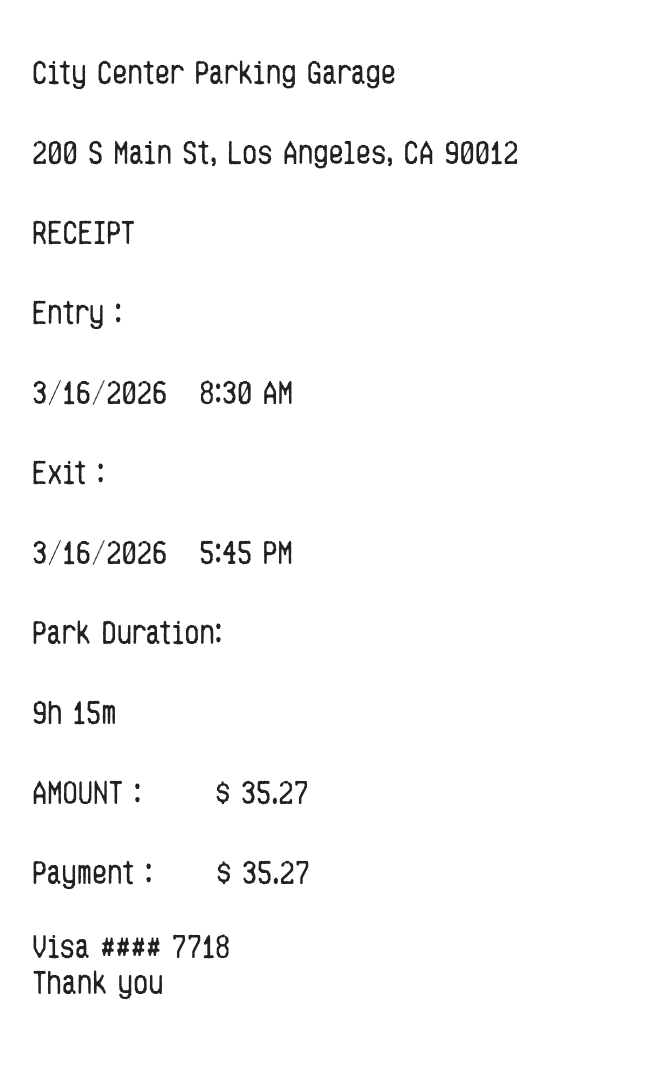
A short receipt for a parking payment
This car parking template centers on one paid amount. It has separate entry and exit fields, an editable duration and optional final card digits. The captions beside these values can be changed too. There is no item list or hourly-rate calculator, making this layout suitable when you already know the final parking charge.
Car parking receipts and business expense rules
A car parking receipt is most useful when it shows the facility, the date, the entry and exit times and the amount paid, because those details tie the charge to a particular trip. IRS Publication 463 (2025) says business-related parking fees, such as parking while visiting a customer or client, are deductible, while fees to park at your own place of business are nondeductible commuting expenses. If you use the standard mileage rate, you can still deduct business-related parking fees and tolls on top of it. Employees should note that unreimbursed employee car expenses are no longer allowed as a miscellaneous itemized deduction, so reimbursement is usually the route for them.
Small parking charges often don't need a receipt under IRS rules. Documentary evidence isn't required for an expense other than lodging that is less than $75, or for a transportation expense when a receipt isn't readily available. Your own record still has to show the amount, date, place and business purpose, and estimated amounts can't be deducted. Employers can set stricter reimbursement rules. For parking an employer provides, IRS Publication 15-B sets a 2026 monthly exclusion of $340 for qualified parking, which means parking on or near the business premises or where employees start a mass transit, commuter highway vehicle or carpool commute, not parking at or near an employee's home.
Recording a parking charge so you can claim it later
Write the business purpose next to each parking charge when you record it. Publication 463 says a record made at or near the time of the expense carries more weight than one prepared later, and a log kept weekly counts as timely. When you ask an employer for reimbursement under an accountable plan, accounting for the expense within 60 days after it was paid is treated as a reasonable period.
What you can change
| Section | Details |
|---|---|
| Facility | Parking name, address and telephone |
| Visit | Entry and exit dates and times |
| Duration | Text entered separately from the times |
| Payment | Paid amount, method and optional card reference |
| Captions | Receipt, amount, duration and thank-you text |
Related receipt guides
Check the stay against the payment
- Replace the example facility.
- Set arrival and departure from the parking record.
- Update the duration text to agree with those times.
- Review the paid amount before export.
FAQs
Official sources
- IRS - Publication 463 (2025), Travel, Gift, and Car Expenses
- IRS - Publication 15-B (2026), Employer's Tax Guide to Fringe Benefits