Cargo Receipt Template for Freight Charges
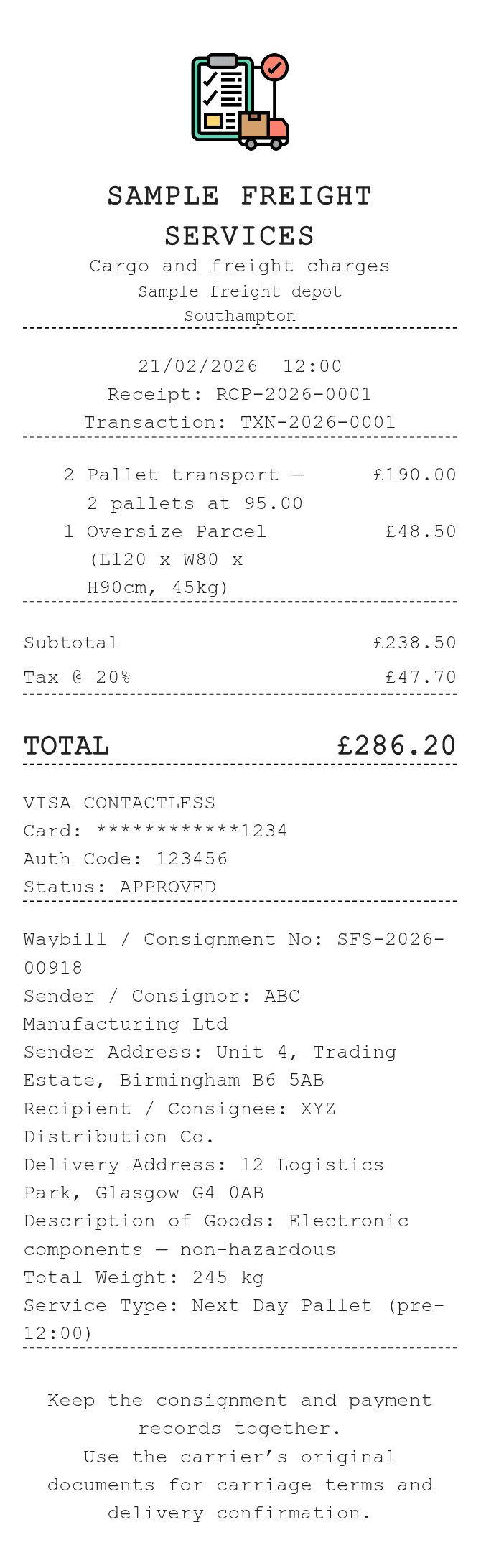
Record the consignor, consignee, goods and weight alongside the freight charges. Review each full line amount and the tax before downloading.
Last updated
Keep the shipment details beside its cost
This cargo receipt has separate fields for the waybill, sender and recipient addresses, goods description, total weight and service type. The charge list can describe pallets, parcels or handling. Weight and quantity are reference details here: enter the complete charge for each line rather than expecting a freight quote from the shipment details.
What a cargo receipt or bill of lading should show
For interstate trucking, federal rules set out what the shipping paperwork must contain. Under 49 CFR 373.101, a for-hire motor carrier must issue a receipt or bill of lading showing the consignor and consignee, the origin and destination points, the number of packages, a description of the freight, and its weight, volume or measurement when that affects the rate. The freight or expense bill for the charges goes further, adding the shipment date, the exact rates, total charges including any special services, the route and each participating carrier, transfer points, and the address where payment is sent.
These details matter if something goes wrong. Under 49 U.S.C. 14706, a carrier can't give you less than 9 months to file a loss or damage claim, or less than 2 years to sue after it disallows a claim in writing. A claim must be written, identify the shipment, assert liability and ask for a specified or determinable amount. Under 49 CFR 370.3, a damage or shortage note on a delivery receipt or freight bill isn't a claim on its own. A cargo receipt that matches the waybill reference, package count and weight makes the shipment easy to identify.
Getting and keeping copies of freight paperwork
The shipper or receiver who owes the charges is given the freight bill, and when a bill is sent electronically, the carrier must give the payer a receipted copy upon payment (49 CFR 373.103). Carriers keep bills of lading, freight waybills and paid freight bills for 1 year under 49 CFR part 379, so ask the carrier for any missing copy soon after the shipment.
For your own tax records, the IRS says to keep most records for 3 years, with longer periods in specific cases, such as 6 years if you leave out income worth more than 25% of the gross income on your return.
Shipment and charge fields
| Section | Details |
|---|---|
| Parties | Consignor and consignee with their addresses |
| Cargo | Goods description and total weight |
| Service | Waybill reference and service type |
| Charges | Description, quantity and full line amount |
| Payment | Tax, total and recorded payment details |
Related receipt guides
Check the freight record
- Replace the sample carrier and shipment details.
- Describe each pallet, parcel or service charge.
- Enter the full amount for each row and check tax.
- Review addresses and references before exporting.
FAQs
Official sources
- eCFR - 49 CFR Part 373, Receipts and bills
- eCFR - 49 CFR 370.3, Filing of claims
- U.S. Code - 49 U.S.C. 14706, Liability of carriers under receipts and bills of lading
- eCFR - 49 CFR Part 379, Preservation of records
- IRS - How long should I keep records?
Related Templates
- Courier service receipt
- Delivery record with recipient details
- USPS Certified Mail Receipt
- COD Receipt
- Commercial Invoice
- DHL Outbound Invoice
- Evri Receipt
- Inpost Receipt
- Ocean Cargo Bill of Lading Receipt
- Purolator Canada Receipt
- Air Force Hand Receipt (DAF Form 1297)
- Canada Customs Invoice
- Freight Dispatch Invoice
- Straight Bill of Lading Receipt