Blank Beauty Receipt Template
Start with an empty receipt for beauty products or services. Add item names, quantities and prices, then set the store details and captions you need.
Last updated
Start without a retailer’s sample details
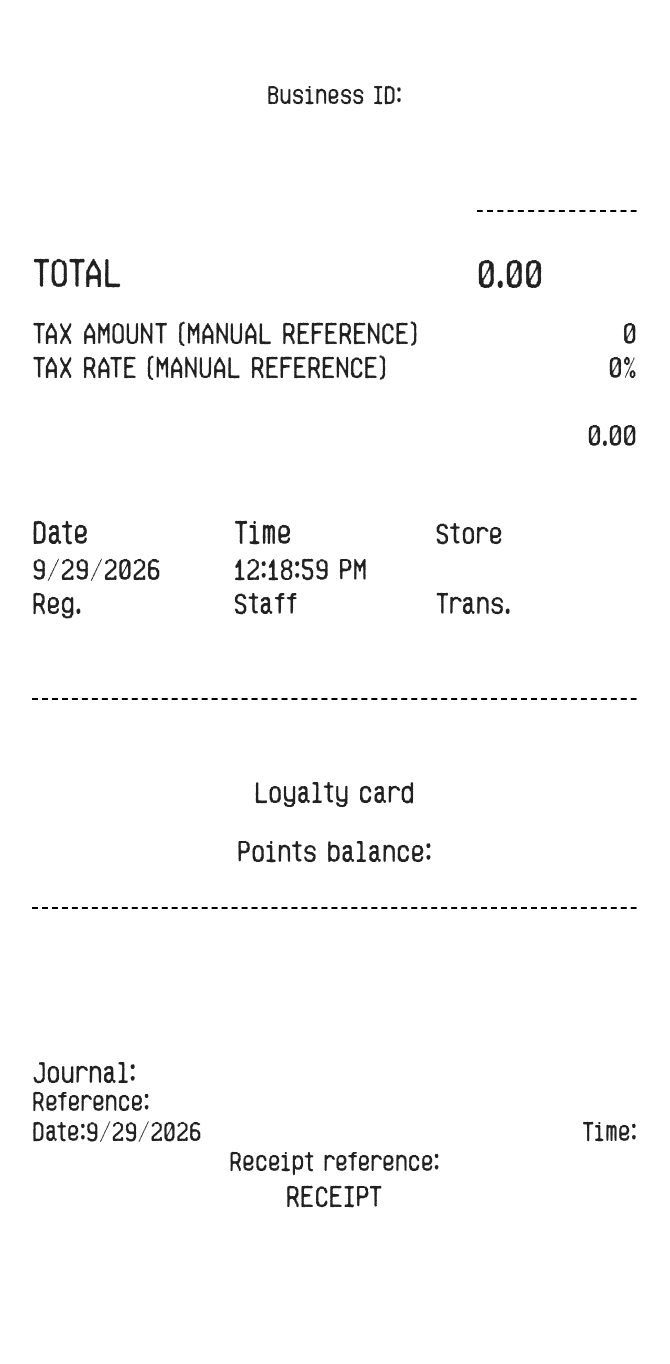
The general beauty receipt opens with blank business and item fields. It suits a small product sale or a service record when a branded store layout is unnecessary. You can edit captions for staff, store, payment and loyalty details as well as the values beside them. Item totals come from quantity multiplied by unit price.
What a beauty receipt needs for business records
For a salon, spa, makeup artist or small beauty retailer, each beauty receipt is part of the business's tax records. The IRS lists cash register tapes, receipt books, invoices, deposit information for cash and credit sales, and Forms 1099-MISC as supporting documents for gross receipts. On the buying side, the IRS says purchase records should show the payee, the amount paid, proof of payment, the date and a description of the item, so it is clear what was bought. A receipt that names the business, dates the sale and itemizes each product or service with its price covers those points for both the seller and a business customer.
Beauty services often include tips, and the IRS treats tips paid by credit card, debit card, check, gift card or a payment app the same as cash tips. Employees must keep a daily record of tips and report them to their employer by the 10th of the following month, unless tips from that employer total less than $20 for the month. A tip counts only when the customer decides whether to pay it and how much. A mandatory charge, such as an automatic percentage added to the bill, is a service charge, and employers treat distributed service charges as wages.
Beauty receipts and the 2025 tips deduction
For the 2025 tax year, the No Tax on Tips deduction lets eligible workers deduct up to $25,000 of qualified tips, meaning voluntary cash or charged tips, including shared tips. The deduction starts to phase out above $150,000 of modified adjusted gross income, or $300,000 for joint filers. The IRS list of occupations that customarily received tips includes skincare workers such as estheticians, shampooers, makeup artists, manicurists and pedicurists, and barbers, hairdressers, hairstylists and cosmetologists. Receipts that show the tip separately from the service price make those amounts easier to track.
A blank layout with editable captions
| Section | Details |
|---|---|
| Business | Address, business ID and store reference |
| Items | Product or service name, quantity and unit price |
| Checkout | Register, staff and transaction references |
| Optional notes | Loyalty card and points entries |
| Tax references | Manual tax rate and manual tax amount, shown separately |
Related receipt guides
Add only the information your receipt needs
- Enter the business details and change any captions that do not suit your record.
- Add the products or services with quantities and unit prices.
- Review the calculated item total. The fields labeled Manual tax rate and Manual tax amount are reference entries; they do not increase that total.
- Complete payment and date details, check the preview, then download the document.
FAQs
Official sources
- IRS - What kind of records should I keep
- IRS - Tip recordkeeping and reporting
- IRS - What the No Tax on Tips deduction means for you
- IRS - Occupations that customarily and regularly received tips on or before Dec. 31, 2024