Moving Receipt Generator
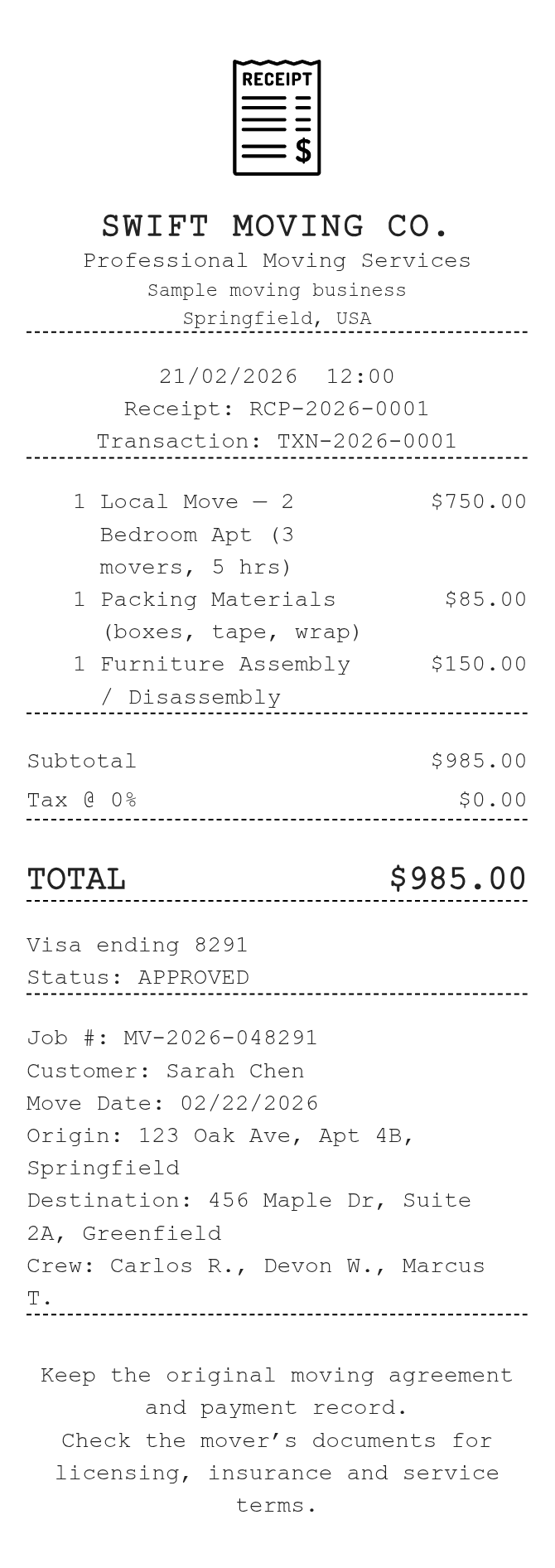
Record moving, packing and assembly charges with the origin and destination. Add the move date, customer and crew, then review the payment details.
Last updated
Tie moving charges to the right journey
The moving template includes a job number, customer, move date, origin, destination and crew. These details distinguish the move from other jobs. Describe labor, packing materials and extra services in separate rows so each complete charge has a clear purpose.
What a moving receipt and bill of lading should show
For an interstate household goods move in the US, the key paperwork is the bill of lading. Federal rules in 49 CFR 375.505 require the mover to issue it before taking your shipment, and it must list 17 items. These include the mover's legal or trade name and physical address as registered with FMCSA, your name and address, the form of payment accepted at delivery, the agreed pickup and delivery dates or periods, the actual pickup date, the payment terms for total charges, any special or accessorial services, and your valuation choice. The binding or non-binding estimate and the inventory become attachments. Both sides sign at origin and destination, and you get a dated copy.
A final moving receipt is easiest to check when it matches those documents. On a collect-on-delivery shipment moved under a non-binding estimate, 49 CFR 375.407 says the mover must release your goods once you pay up to 110 percent of the estimate, plus any extra services you requested and limited charges for impracticable operations, which can't exceed 15 percent of the other charges due at delivery. Anything else is billed later. A receipt that shows the job number, move date, origin, destination, each service and the payment method makes it simpler to compare the amount paid with the estimate and the bill of lading.
Keeping moving receipts for claims and taxes
Keep your dated bill of lading, the estimate, the inventory and every payment receipt together until any damage claim or billing question is settled. The mover must keep its own copy of the bill of lading and of a binding estimate for at least one year, so contact the mover promptly if you lose yours.
For federal taxes, IRS Topic 455 limits the moving expense deduction to members of the Armed Forces on active duty who move under a military order incident to a permanent change of station. Receipts back up unreimbursed costs. Expenses the government reimbursed or paid directly and that were excluded from income can't be deducted.
Move details and service charges
| Section | Details |
|---|---|
| Journey | Origin, destination and move date |
| Booking | Job number and customer |
| Crew | Names or other crew references |
| Charges | Service description and full row amount |
| Payment | Method and recorded payment details |
Related receipt guides
Review the move and payment together
- Replace the mover and customer examples.
- Check origin, destination and the actual move date.
- Describe each charge and enter its complete amount.
- Review tax and payment information before downloading.
FAQs
Official sources
- eCFR - 49 CFR 375.505, Must I write up a bill of lading?
- eCFR - 49 CFR 375.407, Relinquishing a shipment under a non-binding estimate
- eCFR - 49 CFR 375.403, Binding estimates
- IRS - Topic no. 455, Moving expenses for members of the Armed Forces