Fuel Receipt Generator
Enter station and pump details, fuel subtotal, tax amount and the amount paid. Review the volume and unit-price references, and adjust the captions to suit your record.
Last updated
Enter the fuel and payment figures separately
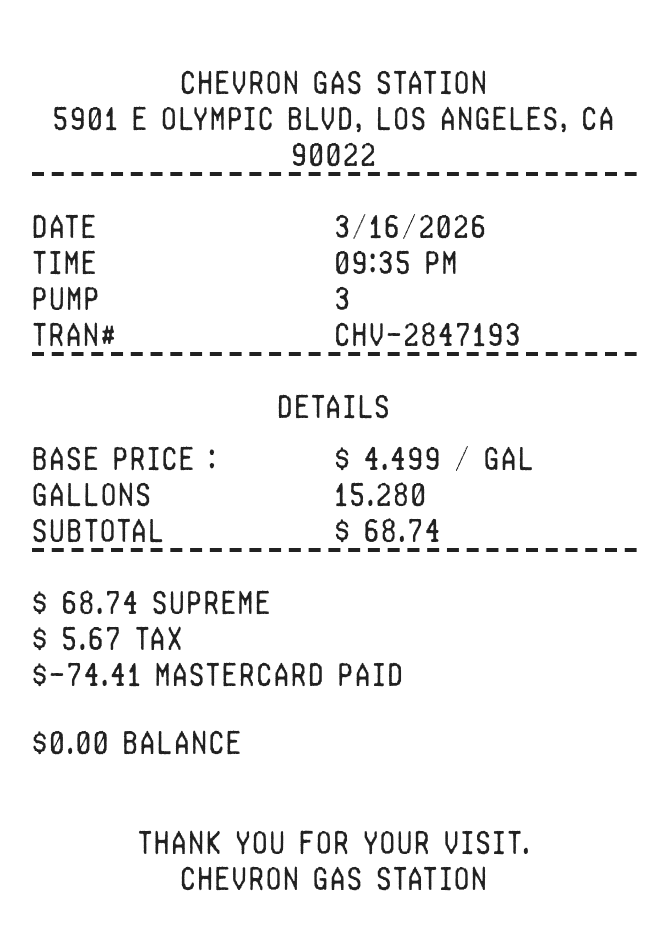
This fuel layout places date, time, pump and transaction references across the top. Below them are the unit-price and volume notes, fuel subtotal, tax and payment. It gives you separate amount fields so you can lay out a purchase record without relying on a volume calculation.
What a fuel receipt needs for expense records
A fuel receipt is often the only record of a business fill-up, so the details on it matter. IRS Publication 463 says documentary evidence such as receipts is generally needed to support business expenses, and it's ordinarily adequate if it shows the amount, date, place and essential character of the expense. For fuel, that means the station name and location, the date, the gallons and grade, and the total paid. Records that support a deduction are generally kept for 3 years from the date you file the return that claims it.
How you deduct driving costs decides whether fuel receipts count at all. If you use the standard mileage rate for a year, you can't deduct actual costs such as gasoline. The 2026 business rate is 72.5 cents per mile from January 1 to June 30 and 76 cents from July 1. With the actual expense method, gas is deductible alongside repairs, tires, insurance and similar costs, but a car used for both business and personal driving must be split by miles driven for each purpose.
Fuel receipts for off-highway and equipment use
Fuel used in a business other than in a registered highway vehicle, such as in generators, compressors, forklifts or bulldozers, can qualify as off-highway business use under IRS Publication 510. The federal tax on that fuel may be claimed as a credit on Form 4136 or refunded. Federal excise tax is $0.184 per gallon on gasoline and $0.244 on diesel.
To support a claim, Publication 510 says to keep the gallons bought and used, the purchase dates, each supplier's name and address with amounts bought, and the gallons used for each nontaxable use. Fuel receipts with gallons and dates make that easier.
Editable details and amounts
| Section | Details |
|---|---|
| Station | Name, address, postal code and closing text |
| Checkout | Date, time, pump and transaction number |
| Fuel references | Grade, gallons, unit and price per gallon |
| Charges | Fuel subtotal and tax entered as money amounts |
| Payment | Method, paid amount and cash-change value |
Related receipt guides
Reconcile the amounts before saving
- Replace the station and checkout examples.
- Enter the fuel volume and matching unit-price note.
- Set the fuel subtotal and tax amount separately.
- Check Paid amount and any Cash change against the intended purchase.
FAQs
Official sources
- IRS - Publication 463, Travel, Gift, and Car Expenses
- IRS - Standard mileage rates
- IRS - Publication 510, Excise Taxes