VAT Receipt Template
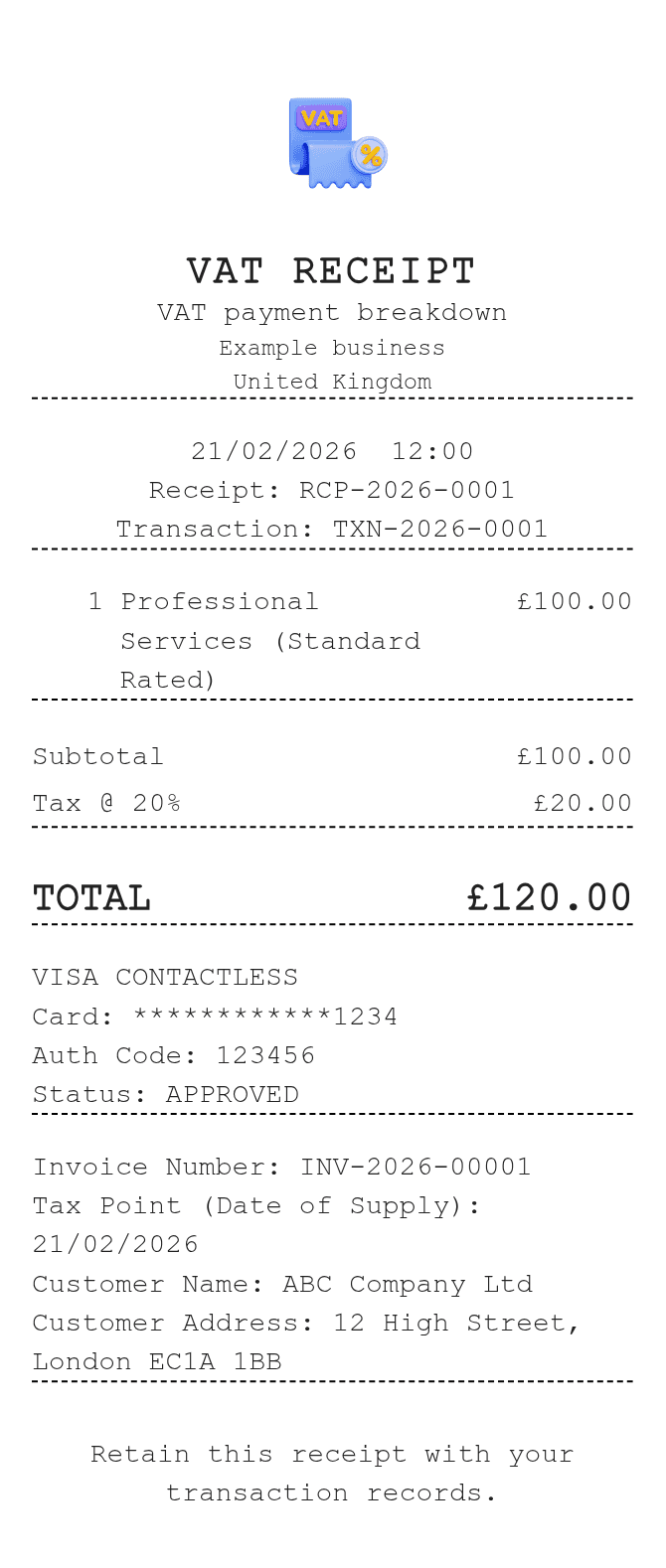
Enter seller and customer details, an invoice reference and the tax point. Add net line amounts and one VAT percentage, then review the calculated total.
Last updated
Keep the tax point beside the invoice reference
This VAT receipt template includes a customer name and address, invoice number and tax point, also labeled Date of Supply. Those details help connect the payment to the relevant sale. The main receipt date and the tax point are separate fields, so check both against the transaction records.
What HMRC expects a VAT receipt or invoice to show
In the UK, only VAT-registered businesses can issue VAT invoices. HMRC's record-keeping notice 700/21 says a full VAT invoice must show a sequential number that uniquely identifies it, the time of supply (tax point), the issue date if different, the supplier's name, address and VAT registration number, and the customer's name and address. For each description it needs the quantity or extent of the service, the VAT rate and the amount excluding VAT, plus the unit price, any cash discount rate and the total VAT in sterling. A VAT-registered seller must normally issue a VAT invoice within 30 days of a standard-rated or reduced-rate supply to another VAT-registered person.
Retailers have lighter rules. They don't have to issue a VAT invoice to unregistered customers unless asked. For a supply of £250 or less including VAT, a retailer can give a simplified invoice showing its name, address and VAT number, the tax point, a description, and, for each rate, the total payable including VAT and the rate charged. Above £250, a customer who asks must receive a full or modified VAT invoice. HMRC treats the invoices a business receives as the primary evidence for reclaiming input tax, so a VAT receipt that lacks these details may not support a claim.
Keeping VAT receipts and choosing the right rate
HMRC says business records for VAT must generally be kept for at least 6 years, and you must keep a copy of every VAT invoice you issue. The current UK rates on GOV.UK are 20% standard, 5% reduced and 0% zero rate, which covers most food and children's clothes. The standard rate has been 20% since January 4, 2011.
A business must register for VAT when its taxable turnover for the last 12 months goes over £90,000, or when it expects to go over that threshold in the next 30 days. Businesses below the threshold can choose to register voluntarily.
Enter the amounts before added VAT
| Section | Details |
|---|---|
| Seller | Enter the business details and VAT registration reference. |
| Customer | Record the customer name and address. |
| Supply | Complete the invoice number and tax point. |
| Net amounts | Enter each row’s full amount before the added tax. |
| VAT percentage | Use the percentage applicable to the recorded transaction. |
Related receipt guides
Do not confuse reference figures with calculated VAT
- Reference VAT rate, Reference net amount and Reference VAT amount are optional notes. They do not change the subtotal, tax or total shown above them.
- The calculation supports one rate across the subtotal. It does not produce separate VAT calculations for mixed-rate supplies or verify that the document meets invoice requirements.
FAQs
Official sources
- HMRC: VAT invoice record requirements
- HMRC - Record keeping for VAT (VAT Notice 700/21)
- GOV.UK - VAT rates
- GOV.UK - VAT registration: when to register