Till Receipt Template
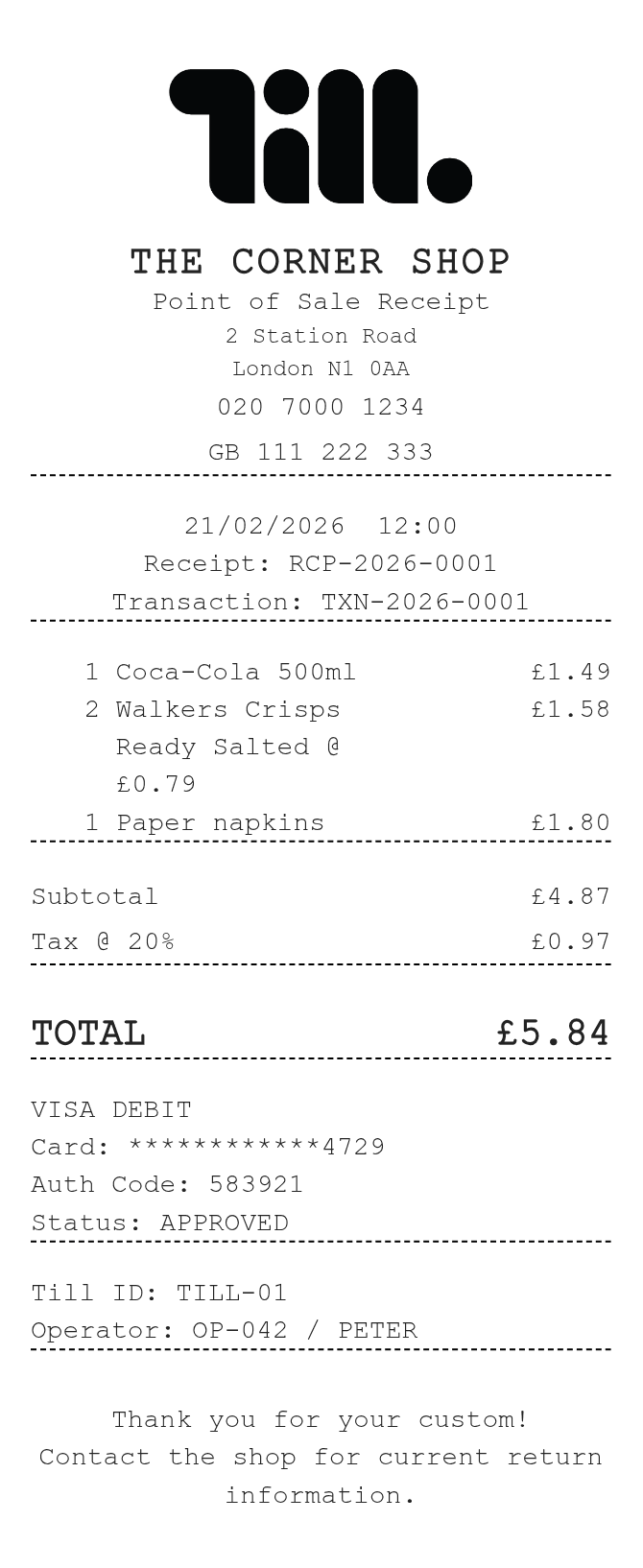
Create a compact till receipt with item amounts, till ID and operator details. Match the checkout references and payment method, then save the finished receipt.
Last updated
Identify the checkout that handled the sale
This till receipt template includes a Till ID and an Operator field, which can help distinguish a sale from others taken at the same shop. The receipt number and transaction reference are separate entries. Start with those details, then fill the item rows from the purchase record.
What a UK till receipt needs to show for VAT
A till receipt is the printed record from a shop's register, and in the UK it can double as a VAT invoice. HMRC's VAT guide says a retailer should give a VAT invoice if a customer asks for one. For a transaction of £250 or less, a retailers' VAT invoice can be used. It shows the seller's name, address and VAT registration number, the time of supply, a description of the goods or services, and for each VAT rate the total payable including VAT and the rate charged. Exempt supplies can't appear on it. For anything over £250, or when the customer asks, a full VAT invoice is required.
If the shop takes card payments, HMRC lets it adapt the card sales voucher into a retailers' VAT invoice by adding its VAT registration number, the VAT rate and a description of the goods or services. On the shop's side, HMRC lists records of daily takings such as till rolls among the business records to keep, and says VAT records generally must be kept for at least 6 years. Where daily gross takings are recorded digitally, the underlying till rolls or Z readings still need to be retained, though they don't have to be stored digitally.
Using a till receipt for returns and refunds
A till receipt isn't the only proof a UK shop can accept. GOV.UK guidance for retailers says a shop can ask for proof of purchase, which could be a sales receipt or other evidence such as a bank statement or packaging. Customers have the same refund rights on sale items as on full-price ones, and displaying a sign that says no refunds is illegal.
For faulty goods, the shop must repair or replace an item returned within 6 months unless it can prove the item wasn't faulty when bought, and customers have up to 6 years to make a claim (5 years in Scotland). For in-person purchases, a shop doesn't have to refund a customer who simply no longer wants an item, so check any returns window printed on the till receipt.
Complete the checkout record
| Section | Details |
|---|---|
| Shop | Enter the shop name, address and contact details. |
| Till and operator | Record the register and staff references. |
| Items | Give each purchase a description and complete line amount. |
| Tax | Review the percentage added to the full subtotal. |
| Payment | Enter the method and relevant card or other payment reference. |
Related receipt guides
Use complete amounts for multi-item rows
- If two packets cost 0.79 each, the line amount is 1.58. Quantity 2 is descriptive; changing it to 3 will not change that amount to 2.37.
- The till and operator fields do not retrieve a transaction. Check the receipt against the shop’s record, including the footer and any return information.
FAQs
Official sources
- GOV.UK - VAT guide (VAT Notice 700), section 16 VAT invoices
- GOV.UK - Record keeping for VAT (VAT Notice 700/21)
- GOV.UK - Accepting returns and giving refunds: the law