Security Deposit Receipt Template
Record a rental deposit with the tenant, property address, date received and payment method. State the deposit type clearly, then check the amount before saving.
Last updated
Name the kind of deposit received
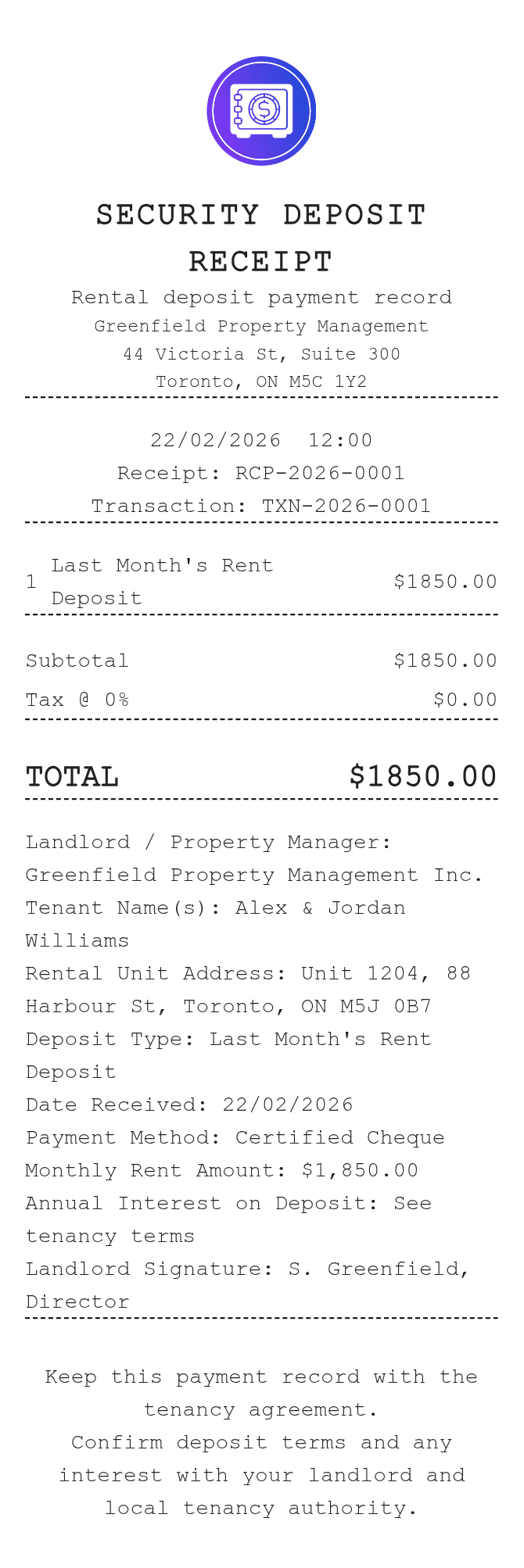
This security deposit receipt template has separate fields for the deposit type, monthly rent and amount paid. The Canadian-dollar example records a last-month rent deposit. That description matters: Ontario tenancy guidance distinguishes a rent deposit from money held for damage, so the two should not be treated as interchangeable.
Security deposit rules in Ontario and California
Ontario's Residential Tenancies Act, 2006 is strict about deposits. Section 105 says the only security deposit a landlord may collect is a rent deposit under section 106. That deposit must be required on or before the tenancy agreement is made, and it can't exceed one month's rent, or one week's rent for weekly tenancies. It must be applied to the rent for the last period before the tenancy ends, not to damage repairs. The landlord pays interest on it every year at the rent increase guideline rate, which is 2.1% for 2026 and 1.9% for 2027. Under section 109, a landlord must give a free receipt for rent, a rent deposit or any other amount on request.
California works differently. Civil Code section 1950.5 lets a deposit cover unpaid rent, damage beyond ordinary wear and tear, and move-out cleaning, but for deposits collected from July 1, 2024 it generally can't exceed one month's rent on top of the first month's rent. Some small landlords who are individuals may take up to two months' rent. Within 21 calendar days after the tenant moves out, the landlord must send an itemized statement of deductions and return the balance. Deductions for repairs or cleaning must be backed by copies of bills, invoices or receipts, or a description of the work, hours and hourly rate when the landlord did it.
What to record on a security deposit receipt
A clear security deposit receipt names the landlord and tenant, gives the rental address, states the amount and date received, and says exactly what the money is. In Ontario, label it a rent deposit for the last month, because the law allows no other kind. Keep each year's interest note with it, and record any top-up if the rent rises, since section 106 lets the landlord ask for one.
In California, keep the receipt with the lease and the move-in photos. For tenancies starting on or after July 1, 2025, landlords must photograph the unit at or just before move-in.
Tie the deposit to the tenancy
| Section | Details |
|---|---|
| Landlord or manager | Identify who received the money. |
| Tenant and property | Enter the tenant names and the full rental-unit address. |
| Deposit type | Describe the payment using the tenancy records. |
| Amount and date | Enter the amount received and its receipt date. |
| Interest and acknowledgment | Record the relevant interest note and landlord name in the provided text fields. |
Related receipt guides
Keep rent and deposit amounts consistent
- Monthly Rent Amount is a separate text entry. It does not set the deposit line amount or calculate interest.
- The Date Received field is also independent of the main receipt date. Review both, and keep the completed receipt with the tenancy agreement.
FAQs
Official sources
- Ontario LTB: rent deposits and receipts
- Ontario - Residential Tenancies Act, 2006 (sections 105, 106 and 109)
- Ontario LTB - Brochure: A guide to the Residential Tenancies Act
- Ontario - Rent increase guideline
- California Civil Code section 1950.5