Expense Receipt Template
Organize business expenses by employee, project and claim reference. Describe each purchase, enter its complete amount, and keep the finished record with the original receipts.
Last updated
Explain the business purpose of each expense
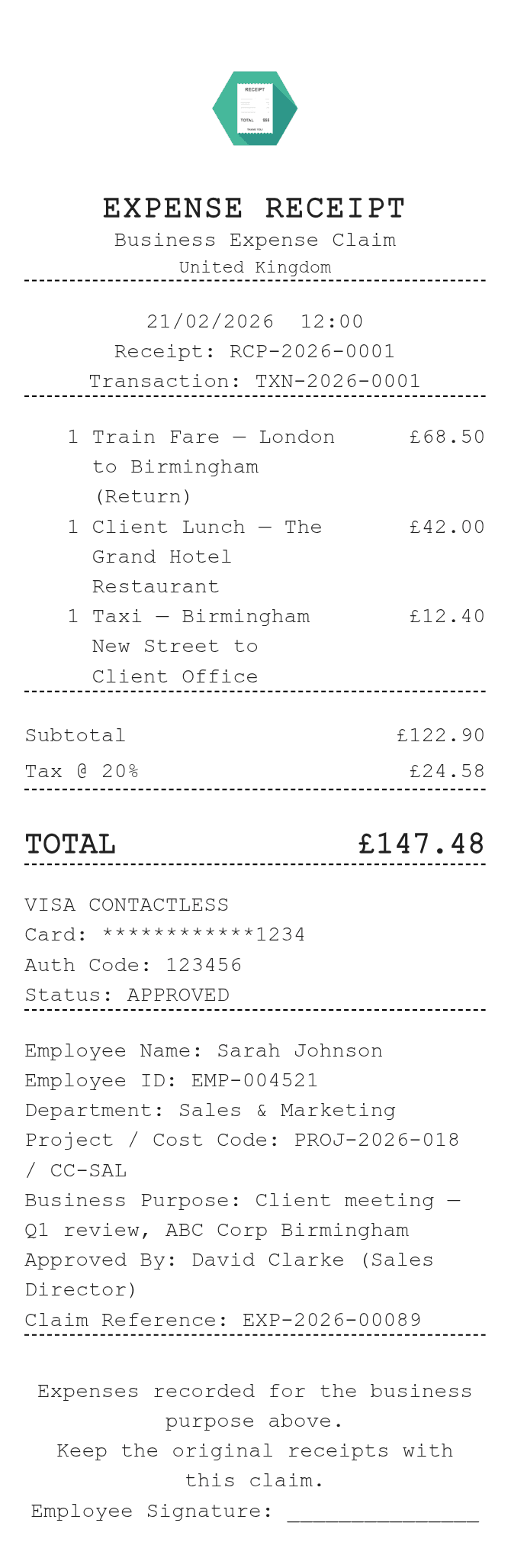
This expense receipt template brings several purchases into one claim record. The employee ID, department and project or cost code help identify where the expenses belong. Use the business-purpose field to explain the trip, meeting or job rather than relying on a total alone.
What the IRS expects an expense receipt to prove
An expense receipt does its job when it proves the four elements the IRS lists in Publication 463: the amount, date, place and essential character of the expense. A hotel receipt should show the hotel's name and location, the dates of the stay and separate amounts for charges such as lodging, meals and telephone calls. A restaurant receipt for a business meal should show the restaurant's name and location, the number of people served, and the date and amount. The IRS also asks for a written statement of business purpose unless the purpose is clear from the circumstances, which is why an expense claim usually carries a purpose line next to the totals.
Receipts are generally required, with a few exceptions. Under Publication 463, documentary evidence isn't needed for an expense, other than lodging, of less than $75, or for a transportation expense when a receipt isn't readily available. Your own record still has to cover each element, and the IRS says you can't deduct amounts you approximate or estimate. A log kept weekly counts as a timely kept record. A canceled check together with the payee's bill ordinarily establishes the cost, but the check alone doesn't prove a business purpose. Publication 583 lists other supporting documents for business expenses, including cash register tapes, credit card sales slips, invoices, account statements and petty cash slips.
Submitting an expense claim under an accountable plan
When an employer reimburses expenses under an accountable plan, the reimbursement isn't reported as pay on the employee's Form W-2. To qualify, the expenses need a business connection, you must adequately account for them, and you must return any excess within a reasonable period. Publication 463 treats accounting within 60 days after the expense was paid or incurred, and returning any excess within 120 days, as reasonable. Amounts you don't account for or return are treated as paid under a nonaccountable plan and are reported as pay.
Keep the original receipts with a copy of each claim. The IRS generally expects records that support a deduction to be kept for 3 years from the date you file the return claiming it.
Match the claim to its supporting records
| Section | Details |
|---|---|
| Employee | Enter the claimant name, employee ID and department. |
| Purpose | Describe the work or meeting connected with the purchases. |
| Expense rows | List each purchase with its supplier or journey and complete line amount. |
| Project and claim | Add the cost code and claim reference used by your organization. |
| Approval | Record an approver only when that approval has been given. |
Related receipt guides
Avoid adding tax twice
- Tax % adds a single percentage to all line amounts. If you are recording the final amounts already paid on the original receipts, check that this setting does not add the same tax again. This layout does not calculate different tax rates for individual expenses.
- Keep the source receipts with the claim and follow your employer's submission process. Typing a manager name does not request approval or send the claim to an expense system.
FAQs
Official sources
- IRS - Publication 463 (2025), Travel, Gift, and Car Expenses
- IRS - Publication 583, Starting a Business and Keeping Records