Jewelry Receipt Generator
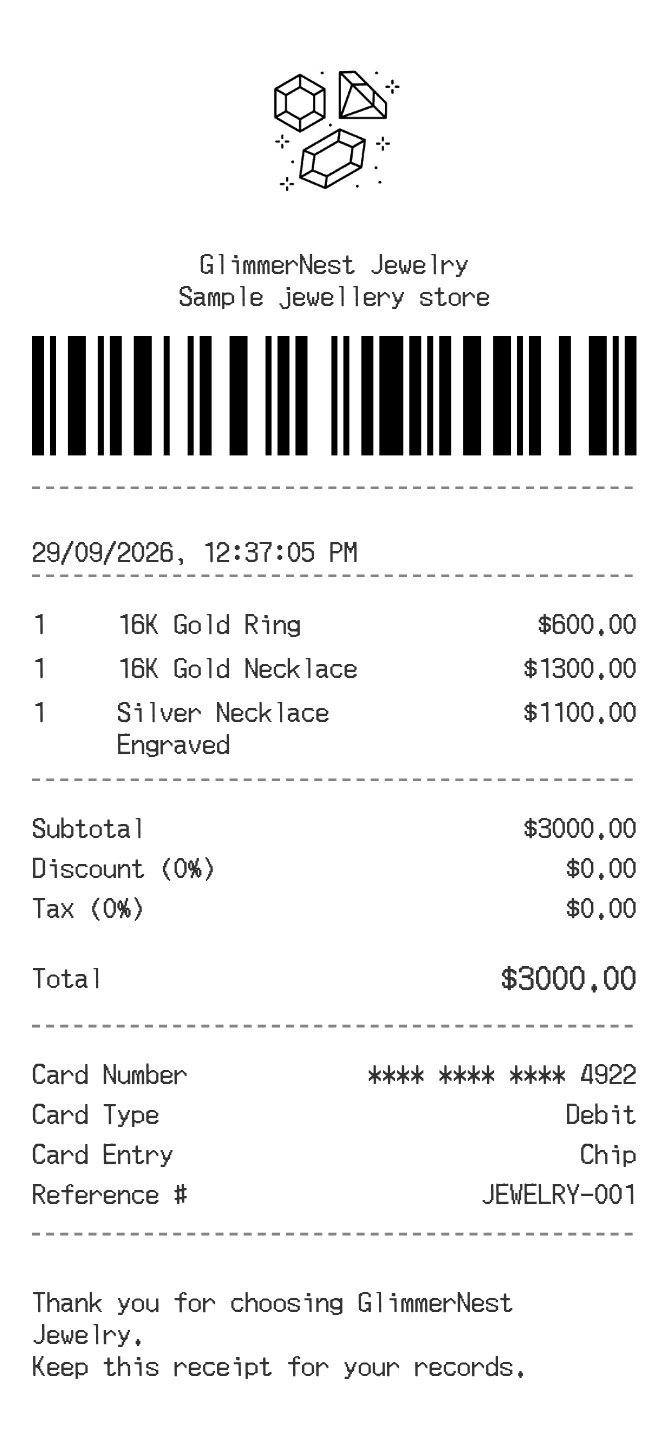
List rings, necklaces or other pieces with their quantities and unit prices. Arrange the store, totals and payment sections, then save the receipt.
Last updated
Give each piece a useful description
A jewelry purchase record is easier to understand when the description identifies the piece rather than saying only “jewelry.” Use this template’s item text for a ring, necklace, engraving or other detail you want to retain. Store information, payment and a closing message have their own editable sections.
What a jewelry receipt should record
The FTC's advice for jewelry shoppers (November 2024) is to make sure your sales paperwork includes the details the seller told you, such as a gemstone's origin, weight or size, treatments and special care requirements. Lab-created and imitation gems should be clearly labeled. Sellers should disclose a treatment that isn't permanent or creates special care needs, and jewelers should also disclose treatments that significantly affect a stone's value. A carat weight given as a decimal should be accurate to the last decimal place, while a weight given as a fraction should come with a statement that it isn't exact and the reasonable weight range. Some jewelers also provide a grading report from a gemological laboratory.
Metal descriptions follow FTC guidance too. A karat mark shows how many parts out of 24 are gold, so 14K means 14 parts gold and 10 parts other metal, and the FTC advises against buying gold jewelry that has a karat mark but no trademark with it. Plated items should be marked with the karat quality of the gold used and the term or abbreviation for the plating; terms such as gold flashed or gold washed mean very thin plating that wears away faster. Silver, sterling and sterling silver describe products with 92.5% pure silver, often stamped 925. To be called platinum without qualification, an item should be at least 95% pure platinum.
Getting the jeweler's terms in writing
The FTC also recommends finding the store's refund and return policies and getting them in writing. Before you pay, check that the jewelry receipt or the paperwork attached to it repeats what the seller told you about the piece, including the metal, stone details and any treatment. If a seller won't put those details in writing, the FTC suggests considering working with someone else. Keep any grading report you were given together with the receipt.
Assembling the receipt
| Section | Details |
|---|---|
| Jeweler details | Replace the sample business name and address in the header. |
| Item descriptions | Describe the piece and add a known reference or material in the item text. |
| Quantities and prices | Use a unit price; the item list calculates quantity times price. |
| Discount and tax | Set the percentages in the totals section and compare the result with your source record. |
| Layout | Move or remove sections, check the preview and select a PDF or PNG download. |
Related receipt guides
Describe only what you know
- Weight, metal purity, stone details and valuation should come from a jeweler’s documentation if you include them.
- This is a purchase layout, not an appraisal or grading certificate. Keep those documents separately when they are available.
FAQs
Official sources
- FTC Consumer Advice - Buying Gemstones, Diamonds, and Pearls
- FTC Consumer Advice - Buying Platinum, Gold, and Silver Jewelry