Delivery Receipt Template for Canada
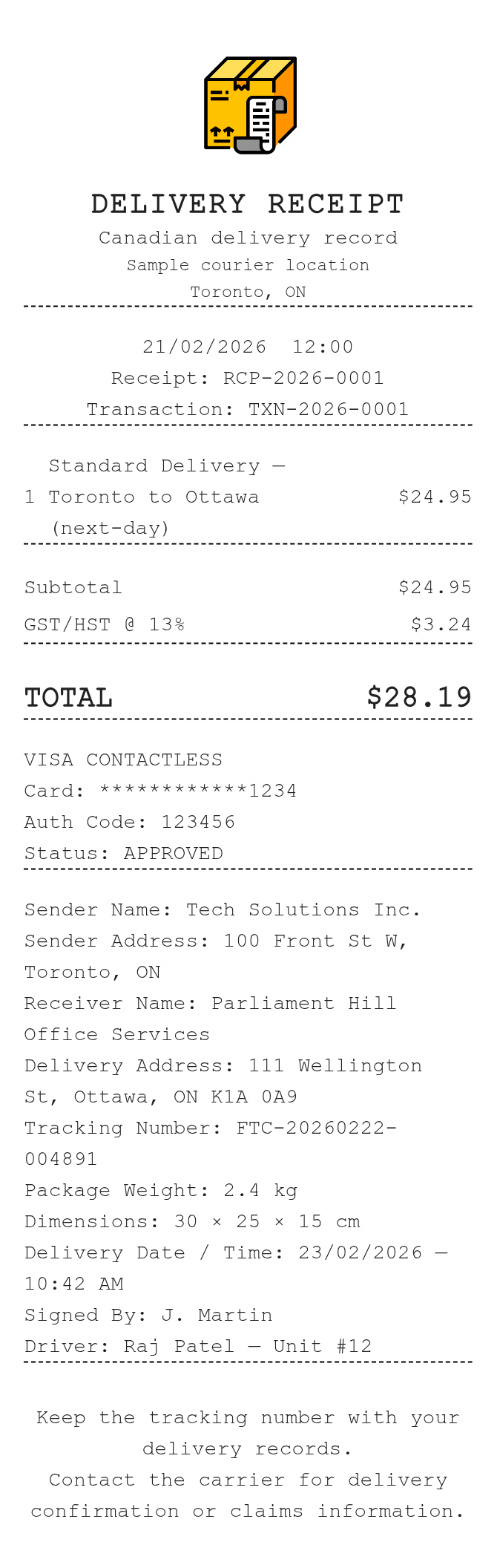
Fill in the sender, receiver, package and driver details. Review the recorded delivery time and GST/HST entry, then download the receipt.
Last updated
Connect a delivery event to its package
The Canada delivery template has separate fields for sender and receiver addresses, package weight, dimensions, tracking number and driver. Delivery Date / Time records the handover independently of the receipt date above. The cost list and GST/HST percentage are editable, so use the figures from the original delivery record.
How GST/HST works on a Canadian delivery receipt
In Canada, the sales tax on a delivery depends on where it ends up. The CRA says freight transportation is supplied in a province if the destination of the service is in that province. For goods sent by mail or courier, the place of supply is the province the goods are sent to. Rates in effect from April 1, 2025 are 13% HST in Ontario, 14% in Nova Scotia, 15% in New Brunswick, Newfoundland and Labrador and Prince Edward Island, and 5% GST in the other provinces and territories, where provincial sales tax may apply separately.
That is the main difference from a US delivery receipt, where state and local sales tax rules vary instead. A Canadian delivery receipt should show amounts in Canadian dollars, name the GST or HST and the rate charged, and give the carrier's GST/HST registration number when it is registered. Most businesses don't have to register until their taxable supplies pass $30,000 over four consecutive calendar quarters, so a small local courier may legitimately charge no GST/HST at all.
What a business needs on a delivery receipt to claim tax back
Under the Input Tax Credit Information (GST/HST) Regulations, the details a registrant needs grow with the total. Under $100, the receipt must show the supplier's name, the invoice date and the total paid or payable. From $100 to under $500, it must also show the supplier's GST/HST registration number and the tax charged, or a statement that tax is included with the total rate. At $500 or more, add the recipient's name, the payment terms and a description of each supply.
For example, a $200 delivery to an address in Ontario at 13% HST shows $26.00 in tax and a $226.00 total, so the receipt falls in the $100 to $500 band. The CRA asks businesses to keep records for six years from the end of the last tax year they relate to.
Canadian delivery-record fields
| Section | Details |
|---|---|
| Addresses | Sender and receiver with delivery location |
| Package | Weight, dimensions and tracking reference |
| Handover | Delivery time, driver and recorded recipient name |
| Charges | Full row amounts and entered GST/HST percentage |
| Currency | Selected symbol for the recorded amounts |
Related receipt guides
Check the dates and delivery details
- Replace the example addresses and carrier details.
- Match the tracking number to the package.
- Enter the actual delivery time and any recorded recipient name.
- Review the charge, tax and currency before export.
FAQs
Official sources
- CRA - GST/HST rates and place-of-supply rules
- CRA - GST/HST calculator and rates
- Input Tax Credit Information (GST/HST) Regulations, section 3
- CRA - When to register for and start charging the GST/HST
- CRA - Where to keep records and how long to keep them