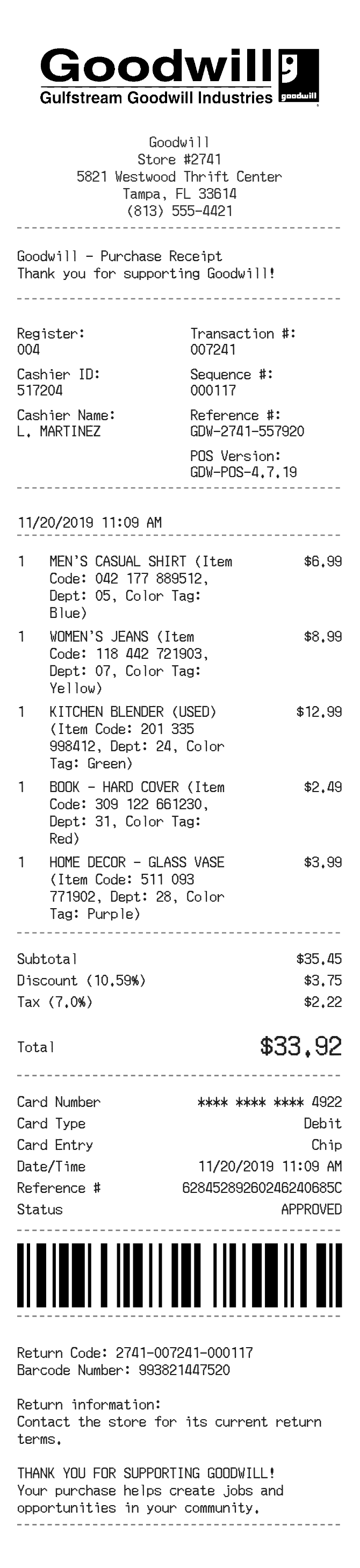
About the Goodwill Receipt
Goodwill receipts document donations of clothing, household goods, electronics, and other items dropped off at a Goodwill donation center. The receipt serves as proof of a charitable contribution, which donors commonly use for tax deduction purposes. People recreate or reference these receipts to record fair market values, replace lost copies before tax filing, or document the contents of a large multi-item donation.
Goodwill in Numbers
Goodwill Industries International was founded in 1902 in Boston by Methodist minister Edgar J. Helms. Headquartered in Rockville, Maryland, it operates as a network of 156+ independent regional organizations across the US and Canada, running thousands of retail stores and donation centers. Revenue from retail sales funds job training and employment services for people with barriers to work.
What Is On a Goodwill Receipt
| Section | Details |
|---|
| Header | Goodwill regional organization name, store or donation center address, phone number |
| Donation date | Date and sometimes time the items were dropped off |
| Donor acknowledgment | Statement confirming no goods or services were exchanged for the donation |
| Item categories | General categories listed (e.g., clothing, furniture, electronics, books, housewares) |
| Item counts | Number of bags or boxes per category, or individual item counts for large goods |
| Donor-assigned value | Blank or donor-filled field for the fair market value; Goodwill does not assign values |
| Tax ID | Goodwill's federal tax identification number (EIN) for IRS documentation |
| Attendant signature | Signature or initials of the Goodwill staff member who received the donation |
| Footer | Reminder that valuation is the donor's responsibility and reference to IRS Publication 561 |
Using a Goodwill Donation Receipt
- Keep your receipt to claim a charitable deduction on your federal taxes; Goodwill is a registered 501(c)(3) nonprofit.
- Goodwill does not assign a dollar value on the receipt โ you are responsible for estimating fair market value using IRS guidelines or tools like the Goodwill Valuation Guide.
- For donations valued over $500, IRS Form 8283 is required; donations over $5,000 generally require a qualified appraisal.
- Goodwill retail store purchases (not donations) follow each regional organization's own return policy, typically allowing exchanges or returns within a short window with a sales receipt.
FAQs
Can I get a duplicate Goodwill donation receipt?
Goodwill donation receipts are issued on-site at the time of drop-off and are generally not stored in a retrievable system. If you lost yours, contact the specific donation center or regional Goodwill organization where you donated; some locations may be able to reissue one if they keep intake logs.
Does a Goodwill receipt show the value of my donation?
No. Goodwill receipts acknowledge that a donation was made but intentionally leave the dollar value blank. The IRS requires donors to determine fair market value themselves. Use the Goodwill Valuation Guide or IRS Publication 561 as a reference.
What information do I need to recreate or reconstruct a Goodwill donation receipt?
You need the donation date, the regional Goodwill organization's name and EIN, a description of item categories and quantities, and the location of the donation center. The Goodwill website lists EINs and addresses by region, which are the critical fields for a valid tax record.
Is a Goodwill receipt enough for a tax deduction?
For donations under $250, a bank record or the receipt itself is sufficient. For donations of $250 or more, the IRS requires a contemporaneous written acknowledgment from Goodwill, which the standard donation receipt provides, as long as it includes the nonprofit's name, EIN, donation date, and the no-goods-or-services statement.
Related Templates