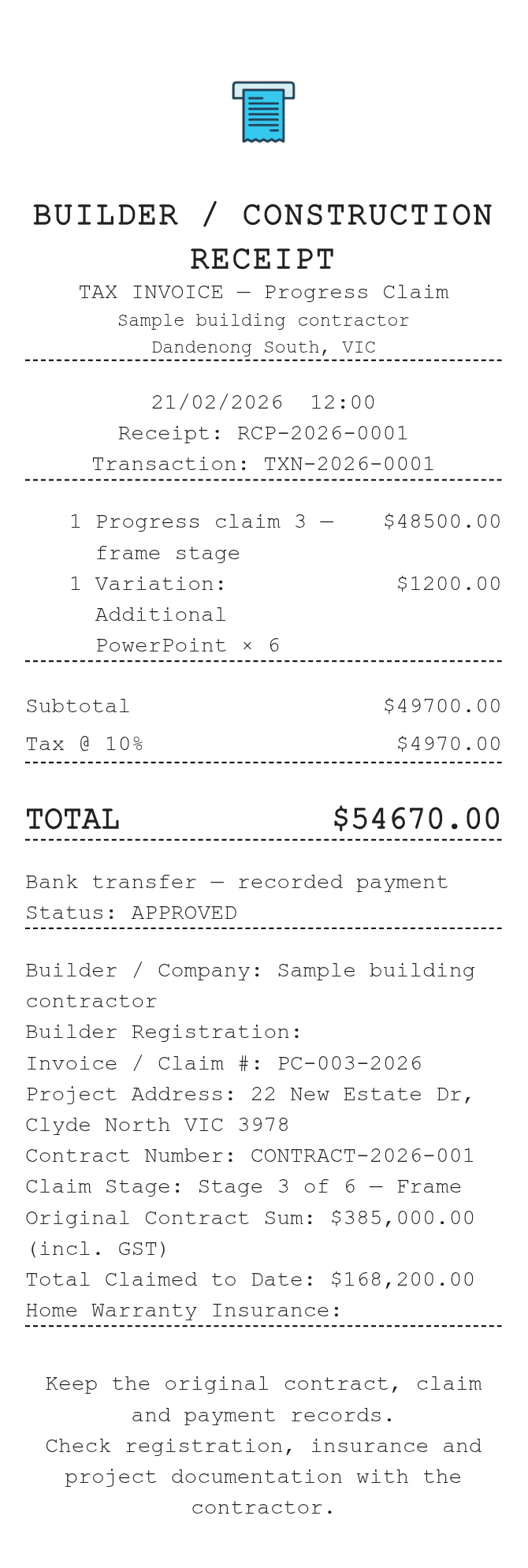
About the Builder / Construction Receipt
A builder or construction receipt documents payment for labor, materials, or contracted work on a residential or commercial project. It typically covers services like framing, roofing, foundation work, renovations, or general contracting. Homeowners, contractors, and subcontractors recreate these receipts to support insurance claims, tax deductions, permit applications, warranty records, or proof of payment when the original document was lost or never formally issued.
What Is On a Builder / Construction Receipt
| Section | Details |
|---|
| Header | Contractor or company name, business address, phone number, license number |
| Client Info | Homeowner or client name, property address where work was performed |
| Receipt Number | Unique invoice or receipt ID for record-keeping and reference |
| Date | Date payment was received or work was completed |
| Scope of Work | Description of services performed, such as roofing, framing, plumbing rough-in, or concrete pour |
| Materials | Itemized list of materials supplied, with quantities and unit costs if applicable |
| Labor | Hours worked or flat labor charge broken out from material costs |
| Subtotal & Tax | Subtotal before tax, applicable sales tax on materials, and total amount due |
| Payment Method | Cash, check number, credit card, or bank transfer notation |
| Signature | Contractor signature or stamp confirming payment received |
Using a Builder / Construction Receipt
- Keep construction receipts with your property records โ they support cost-basis calculations when you sell the home.
- Receipts are often required to activate manufacturer warranties on installed materials like roofing shingles or windows.
- For insurance claims after storm or fire damage, dated contractor receipts help establish pre-loss improvement values.
- Self-employed contractors and homeowners running rental properties can use these receipts to document deductible repair or improvement expenses at tax time.
FAQs
What information is required on a valid builder receipt?
At minimum, a builder receipt should include the contractor's name, license number, the property address, a description of work completed, the total amount paid, the payment date, and the payment method. Many states also require the contractor's license number to appear on all financial documents.
Can I recreate a builder receipt if the contractor never gave me one?
Yes. Using details from your contract, bank statement, or canceled check, you can generate a receipt that reflects the actual transaction. Make sure all figures match your records in case the document is reviewed by an insurer, tax preparer, or permit office.
Should materials and labor be listed separately on a construction receipt?
It is good practice to itemize them separately. In many states, labor on construction work is not subject to sales tax while materials are, so separating the two avoids overbilling and makes tax reporting cleaner for both parties.
How long should I keep builder and construction receipts?
Keep them for at least seven years for tax purposes, or for as long as you own the property if the work constitutes a capital improvement. Receipts for work covered by a warranty should be kept for the full warranty period.
Related Templates