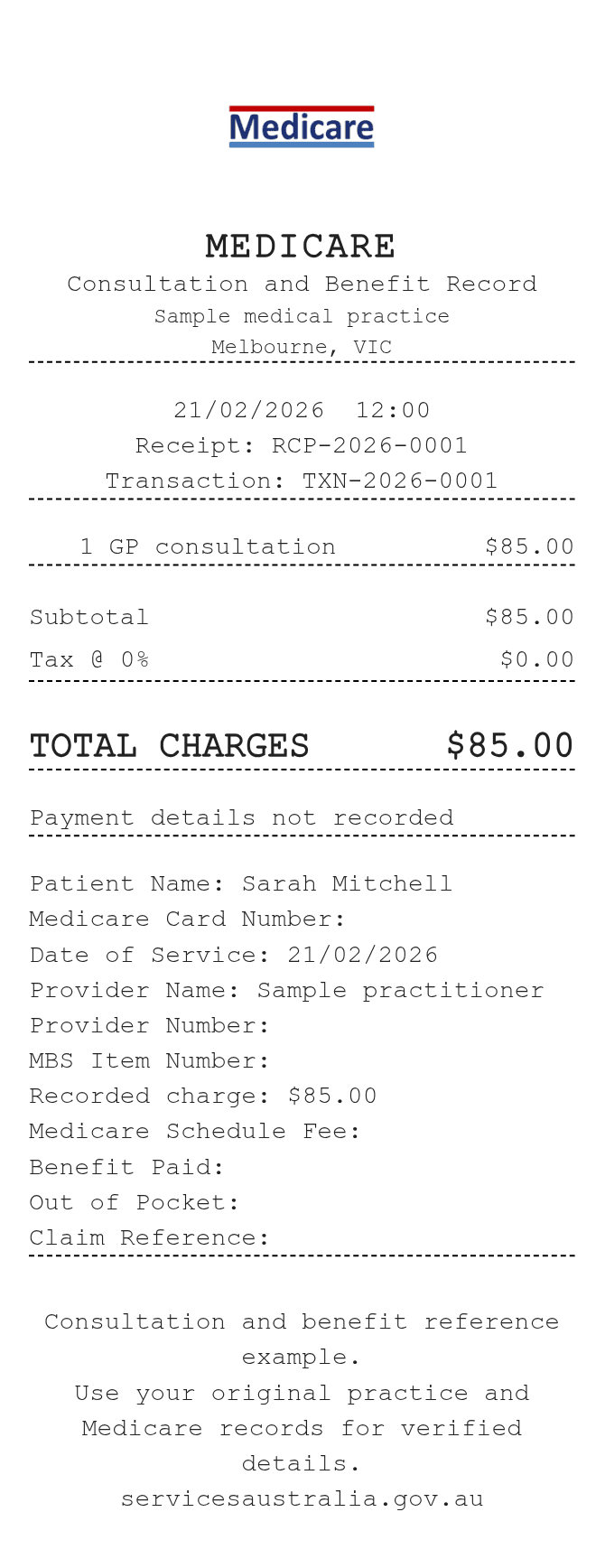
About the Medicare Receipt
A Medicare receipt documents payments made for healthcare services covered under the federal Medicare program, including Part A (hospital), Part B (outpatient/medical), Part C (Medicare Advantage), or Part D (prescription drug) coverage. People recreate these receipts to submit for secondary insurance reimbursement, employer flexible spending accounts, tax deductions, or to replace a lost Explanation of Benefits summary from a provider or insurer.
Medicare in Numbers
Medicare was established in 1965 under President Lyndon B. Johnson as part of the Social Security Act. Administered by the Centers for Medicare and Medicaid Services (CMS), it covers roughly 65 million Americans as of the mid-2020s, making it one of the largest health insurance programs in the world. CMS is headquartered in Baltimore, Maryland.
What Is On a Medicare Receipt
| Section | Details |
|---|
| Section | Details |
| Patient Information | Patient name, Medicare Beneficiary Identifier (MBI), date of birth |
| Provider Information | Provider or facility name, NPI number, address, phone number |
| Service Date | Date or date range when the service was rendered |
| Service Description | Procedure code (CPT/HCPCS), description of service or item provided |
| Billed Amount | Total amount the provider billed to Medicare |
| Medicare Approved Amount | The amount Medicare determined is payable for the service |
| Medicare Paid Amount | Amount Medicare actually paid to the provider |
| Patient Responsibility | Deductible, coinsurance, or copay owed by the patient |
| Claim Number | Unique identifier for the claim, used for disputes or follow-up |
Using a Medicare Receipt
- Medicare receipts and Explanation of Benefits (EOB) documents are used to submit claims to a secondary insurer or Medigap plan for remaining patient costs.
- Keep receipts when paying out-of-pocket for services to support FSA, HSA, or tax deduction claims โ Medicare premiums and cost-sharing are often deductible.
- If a receipt or EOB is lost, contact your Medicare plan, provider billing office, or log in to Medicare.gov to access claim history.
- Providers are required to give you an itemized bill upon request, which can serve as a formal receipt for reimbursement purposes.
FAQs
How do I get a copy of a Medicare receipt or EOB?
Log in to Medicare.gov and navigate to your claims history, or call 1-800-MEDICARE. Your Medicare Advantage or Part D plan provider will also mail EOBs monthly and may offer them through an online member portal.
What is an MBI and why is it on a Medicare receipt?
The Medicare Beneficiary Identifier is an 11-character alphanumeric code that replaced the old Social Security-based Medicare number. It appears on receipts and EOBs to uniquely identify the covered patient and protect against identity theft.
Can I use a Medicare receipt to get reimbursed from my FSA or HSA?
Yes. Out-of-pocket Medicare costs such as copays, deductibles, and coinsurance are eligible FSA and HSA expenses. You will need an itemized receipt or EOB showing the service date, provider, amount billed, and your share of the cost.
What fields are most important when recreating a Medicare receipt?
The most critical fields are the patient name and MBI, provider name and NPI, service date, procedure code, billed amount, Medicare-approved amount, Medicare-paid amount, and the patient responsibility amount. The claim number is also useful for tracking purposes.
Related Templates