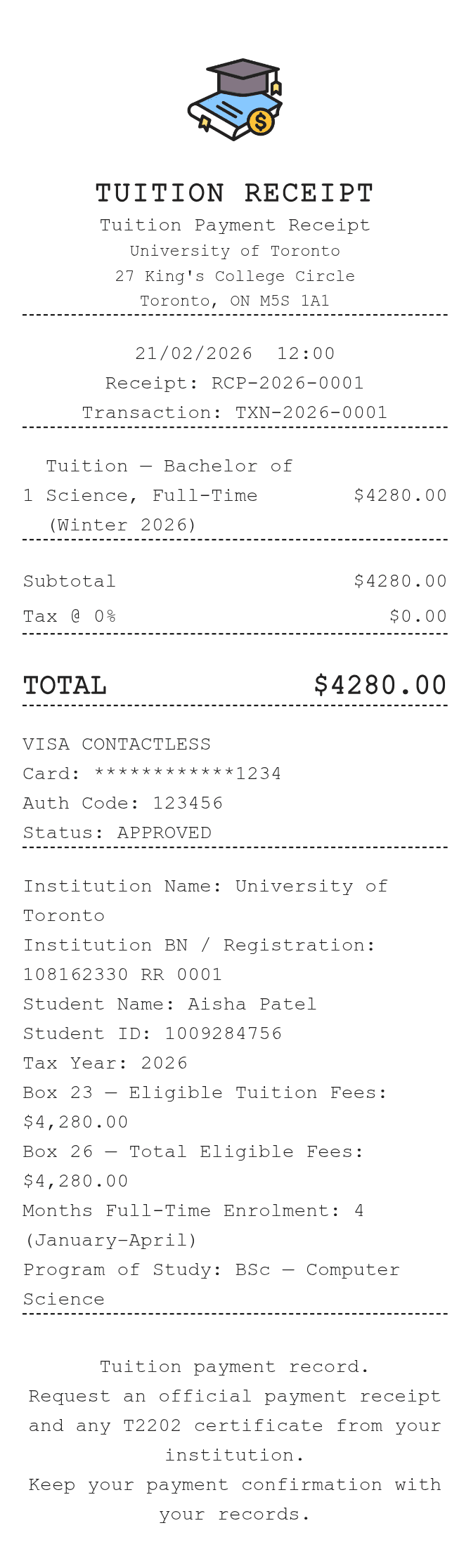
About the Tuition Receipt
A tuition receipt documents a payment made to a school, college, university, tutoring center, or private instructor for educational services. It confirms the amount paid, the student's name, the period covered, and the type of instruction. Parents and students recreate or generate tuition receipts to satisfy employer reimbursement programs, dependent care FSA claims, tax deduction records, or financial aid documentation when an original was lost or never issued.
What Is On a Tuition Receipt
| Section | Details |
|---|
| Header | Institution or instructor name, address, phone, and logo if applicable |
| Receipt number | Unique document ID for record-keeping and reference |
| Student information | Student full name, student ID or grade level |
| Payer information | Parent or guardian name and contact if different from student |
| Payment date | Date payment was received |
| Billing period | Academic term, semester, month, or date range the tuition covers |
| Service description | Course name, subject, program type, or grade level |
| Amount | Tuition fee, any additional charges (activity fees, materials), and total paid |
| Payment method | Cash, check, card, or bank transfer; check number if applicable |
Using a Tuition Receipt
- Keep tuition receipts for at least three years if you plan to claim the American Opportunity Credit or Lifetime Learning Credit on your federal taxes.
- Employer tuition reimbursement programs typically require a dated receipt showing the institution name, student name, and amount paid.
- Dependent care FSA reimbursements for after-school or tutoring programs require receipts that include the provider's name, EIN or SSN, dates of service, and total charged.
- If your school issues a Form 1098-T, compare it against your receipts, as the 1098-T may reflect billed amounts rather than amounts actually paid.
FAQs
What information is required on a tuition receipt for tax purposes?
For IRS education credits, your receipt should show the institution's name, the student's name, the payment date, the amount paid, and the academic period covered. A Form 1098-T from an eligible institution can supplement but does not always replace a payment receipt.
Can I use a tuition receipt for a dependent care FSA?
Yes, but only if the educational service qualifies, typically care or enrichment programs for children under 13. The receipt must include the provider's name, Tax ID or SSN, dates of service, and the amount paid. Standard academic tuition for school-age children generally does not qualify for dependent care FSAs.
What if my school never gave me a receipt?
Contact the school's billing or bursar office and request a payment confirmation letter or official receipt. If you paid by card or check, your bank statement can serve as supporting documentation. For a formatted record, you can generate a tuition receipt using ReceiptEdit and attach it alongside your bank proof.
Does a tuition receipt need to include the instructor's Tax ID?
For private tutors or small tutoring businesses, yes, including a Tax ID (EIN or SSN) is important if you plan to claim a dependent care FSA benefit or request employer reimbursement. Larger institutions will typically have an EIN that also appears on their Form 1098-T.
Related Templates